 Backgound
The fall of 2005 was a truly devastating turning point in my life: my dearest father lost his battle with Non-Hodgkin’s Lymphoma – attributed to his exposure to Agent Orange while stationed in Vietnam. It was a rough summer leading up to his passing as my mother was also diagnosed with breast cancer. My son, Jace, was a rather difficult 2-year-old at the time as I was helping to care for my parents who lived 2-hours away while also maintaining a full-time position as a high school English teacher. After my father’s passing, I returned to college to obtain my Master’s Degree. Unbeknownst to me at the time, I was flinging prana in every direction. My father’s passing projected me into taking on more responsibility in an attempt to cope with the loss. Needless to say, I was devastated and sought comfort in being “busy” – too busy to think about it – what Levine would term as “hypervigilance” (Levine 155). Indeed, my life was a “giant elastic-band ball” (Stone 73).
In hindsight, this “hypervigilant” path lead me to a path of healing. I was so busy that I had abandoned my home exercise routine – courtesy of The Firm – and sought refuge in a local yoga studio. When I first began practicing yoga in 2005, my intention was solely external – to get back into shape. However, this gradually shifted and yoga had become so much more – it became a restorative, healing practice of self-love as well as a means to regain control and maybe loosen those rubber bands. Fast-forward to 2011 when my husband encouraged me to take advantage of a summer-intensive yoga teacher training: my sole intention was not to teach others but to enhance my own practice. So, I set aside my doubts and fears in order to complete the training, and as a result, my svādhyāya truly began. The journey continues thirteen years later as I share my practice, as well as attend classes, festivals, retreats, and trainings. Overtime, my elastic-band ball has diminished in size.
 My Ahaṇkāra of Dvesha
I am a survivor of child abuse and neglect; the abuse I suffered at the hands and from the words of my mother was not only physical, but also psychological. In Levine’s Waking the Tiger, I suffer from Developmental Trauma. According to Levine, “Traumatic symptoms . . . stem from the frozen residue of energy that has not been resolved and discharged; this residue remains trapped in the nervous system where it can wreak havoc on our bodies and spirits.” (19). This was evident in many aspects of my life which became my ahaṇkāra: fear of becoming an abusive parent, fear of change (no matter how small and insignificant), fear and distrust of others, fear of loving and being loved, feeling unwanted, untrustworthy, undeserving, and unimportant. I was even afraid of my own voice (Levine 151, Stone 145). Despite being in choir all through high school, I refused to sing a solo and participate in auditions since my mother’s degrading comments after my first performance in grade school.
On a family trip to Colorado, I remember having my palms read – the reader stated, “You been through this life many times.” Being 7-8 years of age, I was ignorant as to what she meant, much less able to confirm its validity. However, these words have been ingrained in my mind ever since, and have affected the great shift in my perspective from anger and shame to immense gratitude: these experiences of suffering have contributed to making me who I am today: forgiving, empathetic, compassionate, and loving. In fact, it became my purushartas – “[t]hat difficulty is also our potential for liberation.” (Stone 81). After all, “no mud, no lotus.” However, it’s also interesting to note that if I have been through this life many times, my samskara apparently runs deep.
 Svādhyāya
According to Levine, “Body sensation, rather than intense emotion, is the key to healing trauma.” (12). Over the years, yoga has been instrumental in helping me to reveal and transform the deeply-embedded traumas of my childhood. Through the many years of practice, I have learned a lot about myself as the “decades”, maybe “lifetimes”, of suppression and these conditioned patterns surfaced in my practice – my fear of inversions, my difficulty with backbends, a general distrust of my intuition, and even the fear of my voice – all spilled out and exposed on my mat (Levine 149, Stone 21). Through the continued practice and various trainings, yoga became a “transformative” way of life for me (Levine 1); Stone refers to Freud’s “the return of the repressed.” (Stone 73). In fact, I began to identify with the ebb and flow of sensations as “compressed energy” that I have held onto for so many years as they were revealed in my practice (Levine 76). I recall struggling through various asanas in the very beginning, being ego-driven to simply accomplish the posture in the basest physical form. Years later, I was able to connect these sensations with the developmental trauma of my childhood.
According to Levine, “. . . the solution to vanquishing trauma comes not through confronting it directly, but by working with its reflection, mirrored in our instinctual responses.” (65). This quote stood out to me the most: while I have participated in numerous counseling sessions throughout my adolescent years, the true healing occurs on my mat. When I set aside my “ahaṇkāra” (the “I-maker” composition rooted in my traumatic experiences), I try not to focus on the end goal, but on the single, fleeting moment, and how I respond or react to each one physically and mentally – “it becomes a practice of finding within ourselves freedom from being caught in impermanent and limited situations.” (Stone 27, 99). Almost every time I come to my mat, something new is revealed; under the right guidance, an inner freedom is opened or released in the form of an inversion, a back bend, or even singing. It is through these experiences that I also became aware of how my sense of self was heavily based on past experiences and how new information was filtered through that previously determined sense of self (121). Indeed, yoga has become my adaptive process allowing for the gradual renegotiation of the “sheaths of memory” relating to the traumas of my lifetime, and quite possibly the traumas of lifetimes before.
The Tapas
Janet’s equating the sequencing of one’s practice to that of a story was rather curious since “narratives are only ideas” that, according to Stone, “the practice is to move beyond the story line and to stay, with acceptance patience, and curiosity with the changing sensations that appear from moment to moment.” (139, 173). However, Janet’s extended metaphor also really spoke to me as an English teacher; I can visualize the “exposition”, “rising action”, “climax”, “falling action”, and “resolution” in the construct of a class. The exposition is to “expose” or reveal what is already there: characters are introduced and relevant background is provided. As a student/teacher, I always begin the practice with a few moments of complete stillness to silence the mind (savasana, danda pranam, child’s pose, a yin pose, or seated meditation). According to Michael Stone, “the present moment begins in silence” and “everything is crafted out of silence.” (7, 125). In this physical stillness, I focus on what’s already there – in that moment – bringing my attention to the points of contact with Prithvi (earth) to help me ground, then drawing my attention to the Prana and Apana Vayus to enhance my focus and gauge my energy level. In this physical and psychological stillness, the patterns of grasping and inflexibility are revealed (9, 125).
The “story” continues to unfold with the “rising action” – connecting with Apas (water) as I find more fluidity in movement while maintaining a connection to the earth and to the various Vayus as I draw in, ground, circulate, rise, and emanate energy. Beyond the postures, the practice is purely a “technique of moving the body into pure feeling and then dissolve the mind into that deep experience of feeling.” (11, 125). In fact, “the posture sequences open up different layers and movements of mind and body” (118). As the connection between mind and body begins to solidify, I also try to find the balance between steadiness and ease, effort and non-effort. As the Vinyasa flow sequence builds to become more rigorous, Angi (fire) is ignited as the “climax”, and a dramatic shift in the story occurs towards intuitive expression: spurring the creative energy of nirodha by offering an opportunity to tap into one’s intuition by allowing one to alter the sequence by adding, deleting, modifying, or varying postures as intuition dictates. Throughout the flow, there are moments of “staying in the tension of opposites” as I will pause to notice “the patterns and disruptions of breath, the nervous system, the heart rate, the feeling tone” in the physical body – again noting my physical and emotional responses (77, 126, 138).
This energy culminates in the “falling action” of the story – generally in an inversion, followed by a yin or restorative posture to provide an opportunity to connect with Akasha (ether) by creating a space of stillness to pause, to listen, to observe, to notice, as “stillness becomes nothing other than a contented mind that is open and receptive, sharp and still,” – to “sit in the midst of opposition creates the heat necessary for change” and to embrace “the energy of the moment rather than with our storytelling” (11, 78). The “resolution” portion of the class ends with savasana as an opportunity for one to surrender into the infinite – īśvara praṇidhāna. Even in my own practice, I like to begin in stillness and end in stillness – bringing the practice full-circle much like the “life-death cycle of the breath” (34). This stillness is also an opportunity to ““sit with what is arising from moment to moment with acceptance and patience, steadiness and ease” – to go to a deeper level to reflect on what was revealed, released, and/or transformed to “bring about a fundamental shift in perception” (92-3, 116, 127). It is here that one’s true “narrative” arises free of the presuppositions of the old narrative – through an intimate and interior awareness of one’s authentic self and one’s interconnectedness with everything – after all, “[t]here is a whole universe even within one breath cycle” (128-129, 137, 142, 168).
Sankalpa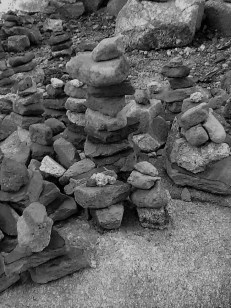
The lessons I have learned in my practice extend well beyond the four corners of my mat – indeed it infiltrates throughout many aspects of my life (173). Over the years, I have become better able to concentrate, more tolerant of change, less reactive to chaos, and more aware of my physical and mental responses – indeed, I am beginning to find comfort in discomfort (128, 143, 145). I am a better mother, wife, friend, teacher, human being. But, as with most journeys, this one continues. There are still moments when I cycle back through the samskara of habits and reactions of the old narratives as I continue to work on “. . . cultivating a kinder and more compassionate story to break down the tendency toward self-judgement.” (Stone 84). But perhaps cycling back is not necessarily a bad thing, but an integral part of the journey because “. . . they are the details and encumbrances that we’ve struggled with most, know most intimately, and have learned how to wrestle, restrain, and transform.” (48). Shifting my perspective has helped me with vidyā – with being with what is (89). But the work is far from complete as I continue to create space in my relationship with myself (179). After all, the most difficult relationship we have is the one we have with ourselves.
Works Cited
Levine, Peter A. Waking the Tiger: Healing Trauma. North Atlantic Books: Berkeley, 1997.
Stone, Michael. The Inner Tradition of Yoga. Shambala: Boulder, 2008.
 Apurva - Yoga with Jenn