 I was first introduced to chanting in 2011 at the Midwest Yoga Conference organized by my first teacher, Jonny Kest. Still relatively new to the world of “yoga” and prior to my initial 200-hour teacher training, I was intrigued with chanting. One of the reasons may be linked to my personal history with singing.
I had been in choir throughout my elementary, middle school, and high school years, but my most memorable singing experience occurred under the guidance of Robert Boyd, a truly talented choir director and composer of our choirs at Lyons Township High School. Under his direction, our class of 1989 Varsity choir became renowned for our ability to break into various parts – some compositions requiring 12 parts, our ability to harmonize, and our ability to tackle difficult compositions – including various foreign languages. One of my favorite and memorable pieces was Charles Stanford’s “Beati Quorum Via” which was 6-parts entirely in Latin. Even without knowing what the words meant, we had an “intrinsic” understanding and could “imagine the energy permeating every cell of our being” every time we performed it (Girish 99, 167). I still hold sacred a cassette tape recording of our candlelight choral performance at a local church. While I may not possess the device necessary to the play it, the music remains vivid in my mind and in my heart. It has indeed permeated my being that almost 30 years later I can still sing it.
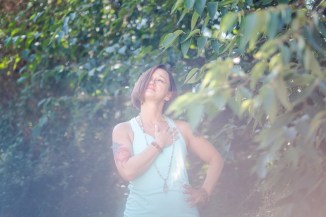 In 2011 at the conference, twenty-two years later, the feelings and sensations experienced as a singer in choir were rekindled as Janet’s Bhakti/Kirtan reopened those very experiences I had those many years ago: surrounded by those who willingly and without reservation shared their voice to create a community full of sound and vibrations. However, rather than the heavy regimen of “perfect practice” from the choral experience, we were simply offered an opportunity to “feel and enjoy an embodied experience of the peace, love, and wisdom within” (87, 139).
Singing with a group comes relatively natural to me, but it was also safer. After a harrowing experience, my first solo audition became the end of my ever becoming a soloist. I barely trusted my choir director enough to audition for Girl’s Choir and Varsity Choir, thus I could never bring myself to sing alone in front of others. Despite being a yoga teacher since 2011, it has only been in the past two years that I have been courageous enough to incorporate chanting into the classes I teach. What started with closing my classes with three rounds of Om, gradually evolved to incorporate more elaborate chants that were more or less dictated by the moment. As suggested by Janet, I began small and started to incorporate more as students became more comfortable. Frequently, I often find myself singing solo as some still choose to listen rather than participate. As such, I have to conquer my fears, and I allow myself a opportunity to ground and connect with my breath and my heart beat.
 As I continue my journey, I have noted the healing qualities that yoga and singing has provided for me. Unbeknownst to me at the time, singing was healing as Dr. Hansen’s “Taking in the Good” outlined by Girish as “HEAL.” (97). I always had a positive experience in practice and in performance, and this experience was enriched and extended in so many ways, to include life-long friendships. Together, we absorbed the energies and qualities of the experience to provide phenomenal performances that not only the choir experienced, but also the audience. It is only upon reflection of this course and the reading of Girish’s Music and Mantras that I have noted the final step of the healing process: “link positive and negative material.” As the old adage states, “hindsight is 20/20”.
One of the more elaborate chants that has always moved me personally is “Hanuman Bolo” – often moving to me tears. Hanuman embodies supreme selfless devotion, strength, courage, and humility in the absence of ego, qualities that I have either discovered within myself or am still seeking to find. Considering my transition to singing in front of others, even a cappella, did require strength and a hell of a lot of courage! As a survivor of child abuse, I have a lot of fears, to include the fear of change; now “Hanuman Bolo” immediately comes to mind whenever I need to take a “leap” into the unknown.
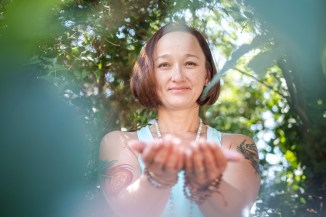 Since this training, chanting has become much more embedded in my practice in that no practice is complete without it; I frequently find myself completing ajapa mantras to close out my own practice in other classes, and I never end any of my classes without at least a few rounds. I also want to integrate the Surya Mantra into my own practice then possibly into my classes. While I currently sing a cappella, I would also like to start incorporating some droning using my shruti box and, possibly, one day, the harmonium.
Photo Credit: Sanjin Kastelan
Work Cited:
Girish. Music and Mantras: The Yoga of Mindful Singing for Health, Happiness, Peace, and Prosperity. New York: Atria, 2016.
 Apurva - Yoga with Jenn