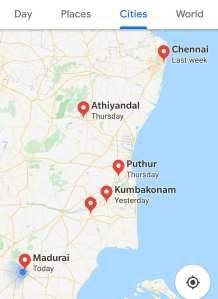
The New Year’s Pilgrimage through India revealed a practice that extends well-beyond one’s mat. Throughout the 188+ miles traveled through the province of Tamil Nadu, I found myself often reflecting on Patanjali’s Yoga Sutras – yoga in action, in devotion, and in daily life. It was inspiring not only to witness but encouraged to participate in a journey of self-study (Svadhyaya).
I have enjoyed traveling and visiting other countries with the Sangha and our teacher, so India was a unique opportunity (rāga). However, there were so many unknown variables and risks: traveling alone, being on an airplane for 20+ hours, and being in a foreign country to name just a few (dveṣa). For me, the journey began with Ahimsa (nonviolence): having the courage to set aside my fears and reservations about traveling to India. According to Deborah Adele’s The Yamas & Niyamas: Exploring Yoga’s Ethical Practice,
“Seeking out people and experiences we would normally avoid provides a fertile place to learn new things about ourselves and about life.” (23).
The dualities of power and powerlessness were strong . . . what to pack, flight schedules, transport, annoculations, and immunizations. Truthfully, I was in need of compassion . . . “[w]e learn compassion as we dissolve our personal version of the world, and grow gentle eyes that are not afraid to see reality as it is.” (37). This was a unique experience to explore without any judgement or expectations – to be a visitor to the human experience (62). 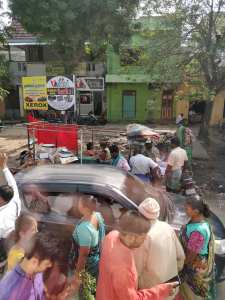
On the first day in India, Satya (truthfulness) unveiled itself. In a desire to explore the city of Chennai and to combat jet-lag, I attempted an excursion. Unfortunately, I was completely unprepared for the sensory overload: the colors, the constant honking of horns; thousands of people on foot, bicycles, scooters, mopeds, motorcycles, tuk-tuks, cars, vans, taxis, and buses all vying for a turn on the road. My anxiety and fear were exacerbated when the Uber driver, who spoke very little English, seemed unsure of where he was going. My inability to “stay present in life no matter what its initial unpleasantness” manifested itself in motion sickness, so I returned to the safety of the hotel (53). Afterall, “[t]here is a profound courage to this kind of willingness to be raw with reality as it is, rather than to run from it or construct a barrier to soften it.” (54). Clearly, India cannot be forced – a reminder that by forcing an experience, I was actually stealing (Asteya) from it.
The lessons learned from this attempted excursion created a real opportunity for growth, particularly with regards to Patanjali’s Yoga Sutras. While all of the moments in India were memorable, there are specific ones I frequently reflect upon: the street vendor outside of the Sri Ramanasramam in Thiruvannamalai, the Puja Ceremony with Shiva Kumar, the early morning pradakshina (circumambulate) around Mt. Arunachala, and the visit to Brihadeeswara Temple in Thanjavur. In all these instances, there was sacredness in community.
The Vendor and His Wife
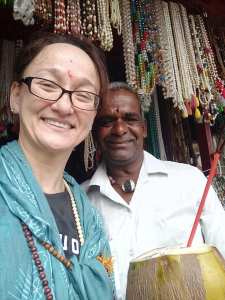
A few days into our Pilgrimage, I bravely decided to venture via Tuk-Tuk into Thiruvannamalai to do a meditative practice at Samadhi Hall of Sri Ramanasramam. Afterwards, I took a walk around the grounds and proceeded along the main street just outside of the ashram where I came upon a vendor selling malas. When I inquired if she had a sandalwood mala, she immediately asked her husband who appeared from behind the cart with a separate bag. He presented me with a beautiful and fragrant sandalwood mala. Not only did he offer a great price, but he also blessed it (Brahmacharya). He also suggested that the mala be worn underneath, next to the skin to keep the blessing close to my heart. After asking if I knew how to use it for japa mantras, I demonstrated with the beads between my index and middle finger using my thumb to pull each bead through; he suggested placing the beads between my ring and middle finger instead to avoid the index finger from touching the beads (the index finger is associated with the Ego) (Satya).
After handing him my payment, his wife presented me with an additional mala as a gift (Aparaigraha). The vendor returned with my change and directed me to take a seat in the shade from the midday heat. He then asked his wife to procure a fresh coconut (Ahimsa). Despite my respectful decline, he insisted that it was no trouble. I found myself graciously and gratefully surrendering into the moment (Santosha/Ishvara Pranidhana). Sitting in the shade enjoying the fresh coconut milk, I reflected on Asteya (nonstealing). According to Adele,
“[t]he ownership of things is steeped deep in our language and culture and makes it hard for us to appreciate the extent to which nothing is really ours . . . the bounty of the earth is for the community, not the individual.” (63).
Despite my being a foreigner, the vendor and his wife welcomed me into their community with great compassion and generosity – making a basic economic transaction a very sacred experience.
The New Year’s Eve Puja Ceremony


Having been able to participate in two Puja ceremonies while in India, the most powerful ceremony was led by Shiva Kumar on New Year’s Eve. A few factors set this ceremony apart from the Puja at the Nataraja Temple in Chidambaram. First was the collaborative effort of the Sangha in the creation of the yantra (sand mandala) and the pushpam (flowers). Additionally, the ceremony was private, involving only our Sangha as opposed to the very public setting at the Temple; this privacy created a space of trust and encouraged vulnerability.
For me, the preparation for the Puja ceremony revealed many aspects of the Yamas. While I have assisted in the creation of a Buddhist sand mandala using tools, this was a new experience using only my hands. I had to find courage in not knowing how in order to learn (Ahimsa); I had to focus on self-expression rather than perfection or how it should be; (Satya); I had to curb my desire to help others so as not to take away from their experience (Asteya); I had to focus on the sacredness rather than the reward of a finished product (Brahmacharya), and I had to let go of the need to complete it (Aparigraha).
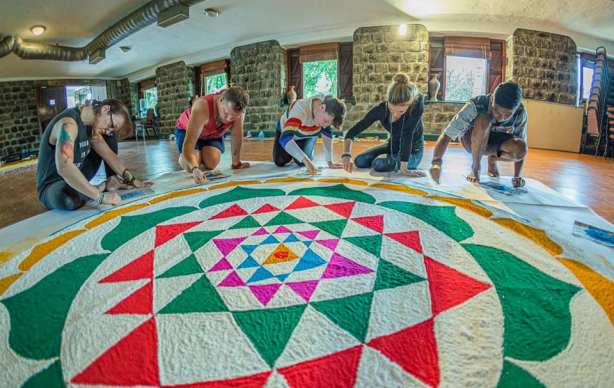
Photo Credit: Wari Ananda Om
With my hands stained by the colored sand and still fragrant from the flowers, nothing had prepared me for what I was about to experience. All of the preparations of the day culminated in an awe-inspiring setting that took my breath away when I entered the space. The completed, brightly colored yantra was fully illuminated by the strategically placed earthen and brass oil lamps, along with the sculptures of idols Shiva, Ganesh, and Hanuman.
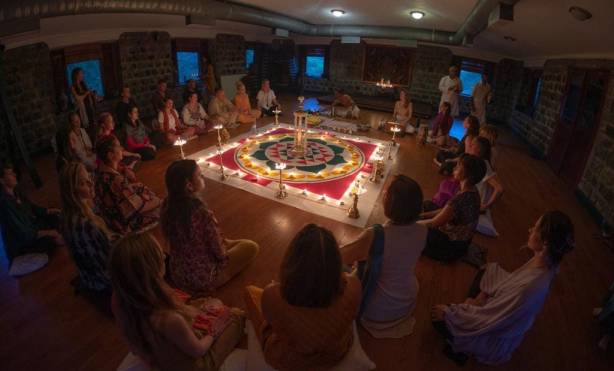
Photo Credit: Wari Ananda Om
One of the required texts for the Pilgrimage was William Dalrymple’s Nine Lives: In Search for the Sacred in Modern India. Each chapter explores the lives of nine people from different belief systems, and each was very interesting. However, the chapter that really resonated with me and reflected the Puja Ceremony was the “The Maker of Idols”. Srikanda is “a Brahmin and an idol maker (Stpathy) who creates bronze sculptures used in various Hindu ceremonies (171). According to Srikanda, “The gods created man . . . but here we are so blessed that we – simple men as we are – help to create the gods.” (171). Practicing Aparigraha (non possessiveness), he states, “once the deity takes on the form of the idol and becomes alive, it is no longer mine.” (174). Throughout the chapter, he reveals the many rituals (Shilpa Shastras) associated with the creation of these idols, including the incantations before (Admartha Slokas) and during (Dhyana Slokas), “You need to maintain not just your skills, but also your discipline” (Tapas) (191-193).
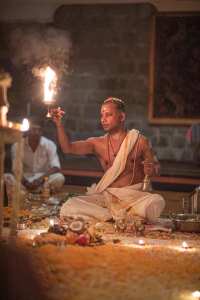
Photo Credit: Wari Ananda Om
Srikanda states, “Without faith, of course, it is just a sculpture. It’s the faith of devotees that turns it into a god.” (174). During the Puja ceremony, Shiva Kumar, our priest, invoked the jivan (life) into the deities through the use various sensory offerings: dhupam (incense), aarti/deepam (light), naivedyam (food), jalam (water), mantram (recitation of sacred verses), ghanti (ringing of the bell), and pushpam (flower petals). Members of the Sangha were also given the opportunity to participate in the offerings through singing and pushpam. It was truly an ethereal experience. The experience reminded me of the “eye-opening” ceremony recounted by Srikanda, “My father acted as the priest, invoking the deity to enter the statute, slowly chiselling open the eyes, and I sat there in a state that was part nerves, part excitement, and part intense devotion.” (198).
Indeed, intense devotion has a way of creating intense emotion. As this was a private ceremony, I felt a sense of security that enabled me to be real and vulnerable (Satya). Of all the moments from the ceremony, there are two that are deeply embedded in my mind and in my heart. The first occurred after a round of singing, our teacher circulated to perform tilaka (the application of the kumkum powder). I was overcome with emotion when she knelt down before me, and our eyes met. Her gaze seemed to invite me to “dive deep into the ocean of the heart.” (239). There, feelings of immense gratitude arose that, even now, brought tears to my eyes. During this dramatic pause in time and space, I acknowledged the divineness that resides deep within her as well as within myself.
Another chapter from Dalrymple’s Nine Lives that resonated with me during the Puja Ceremony was “The Song of the Blind Minstrel.” This chapter recounts the stories of a group of wandering minstrels (Bauls), whose “goal is to discover the divine inner knowledge” as a means to acquire power over the self (227-229). Kanai states, “The happiness and joy that comes with the music helps you find God inside yourself.” (251).

Photo Credit: Wari Ananda Om
The second memorable moment occurred during aarti. As I nervously approached my teacher who was holding the camphor lamp, I paused; she smiled and said, “step into the fire”. Stepping closer, I cupped my hands, waved them over the flame, swept them over the crown of my head, cupped them over my eyes, and rested them over my heart. The chapter titled “The Lady Twilight” from Dalrymple’s Nine Lives, Manisha states, “It is within you that you find the loving shakti of the Mother. This is the place for its realisation, for illumination.” (202). It was then that I realized that part of my Svadhyaya has been to reclaim my own creative power and energy of the divine feminine which had been suppressed in order to rely more on masculine energy as a means of self-preservation.
The Pradakshina
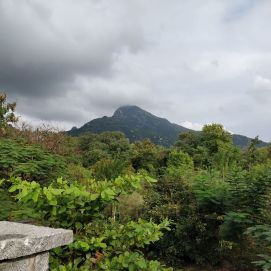
The Niyamas were really evident to me in the early morning pradakshina (circumambulate) around Mt. Arunachala. The approximate 8-mile hike around the mountain through the town of Thiruvannamalai revealed India’s finest of all treasures – its people. I found myself straying from the group as “[o]ur seeing is limited by all the groups that shape us, as well as by our experience.” (Adele, 51). Unbeknownst to me at the time, the hike evolved into a walking meditation. I was indeed content with not seeking but witnessing reality (Santosha). With each and every passerby, I made an intention to connect without judgments, expectations, or assumptions. To truly see one another and be seen,
“[w]e learn compassion as we dissolve our personal version of the world, and grow gentle eyes that are not afraid to see reality as it is.” (37).
Similar to darshan, “it [is] the exchange of vision – the seeing and the seen.” (Dalrymple, 185). For me, it was also a practice of Svadhyaya (self-study). Each greeting was so powerfully moving: an exchange of reverence, respect, and honor leaving me deeply humbled and so very grateful. It reminded me of Kanai’s statement in “The Song of the Blind Minstrel”,
“The joy of walking on foot along unknown roads brings you closer to God. You learn to recognise that the divine is everywhere . . .” (237).

And the divine was indeed everywhere. As the sun rose over Mt. Aranchala, the quiet streets gradually became more alive with people, cars, tuk-tuks, motorbikes, dogs, chickens, and, of course, cows. Of all the activity, one common practice stood out: the early morning ceremony of women sweeping and washing the entrances to homes or businesses, then marking colorful rangoli patterns on the doorsteps. It also brought to mind Dalrymple’s account in “The Maker of Idols”, “Farther up the street, the girls of the village were busy sweeping the fronts of their houses and making rangoli patterns with rice powder on their doorsteps.” (176). This seemingly basic ritual revealed many of the Niyamas: the cleanliness of Saucha, contentment of Santosha, daily self-discipline of Tapas, and the devotion of Ishvara Pranidhanna. Upon further research, the rangoli inspires strength, generosity, and it is believed to bring good luck. Despite the mishap of stepping in cow dung and the huge, painful blisters on the backs of my heels, I was truly honored for the opportunity to witness not only the Niyamas in action but how they created a sense of sacredness in the community.
Darshan at Brihadeeswara Temple
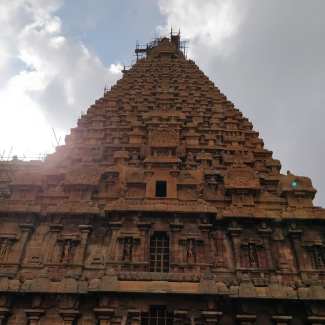
The sense of sacredness in community was evident during our various temple visits. Of all the temples, the Brihadeeswara Temple in Thanjavur was the most memorable – also described in “The Maker of Idols” of Dalrymple’s Nine Lives. It was a bright and warm mid-morning with a moderate gathering of people. As we entered through the South gate, we set aside our shoes and proceeded through the Gopurams to join the procession, passing the Nandi who stood guard in front of the Sri Vimana sanctum. Many people scurried to find a place in line between the interlocking metal sanctions used to que the flow of people for darshan. The incense was fragrant and created an air of auspiciousness. In fact, the incense used in temples often follow the Ayurvedic principles in which the ingredients derive from the five elements. 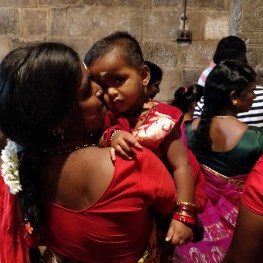
While it was warm outside, it was definitely cooler inside the sanctorum. Unlike many of the other temples we had visited, Sri Vimana was devoid of a lot of artificial lighting. The limestone under my bare feet was cool and smooth while my eyes took in the array of brightly colored saris and lungis. In front of me was a woman holding her little girl who appeared in need of a nap. In “The Maker of Idols”, Srikanda states,
“All these people have a lot of worries – about money, about family, about work. But when they come to the god in the temple . . . for a while their problems vanish and they are satisfied.” (178).
As the procession slowly made its way towards the inner sanctum for darshan, all who waited were hopeful and grateful. According to Dalrymple, darshan is “to actually see the beauty of the divine image, and to meet the eyes of the god. The gaze of the bronze deity meets the eyes of the worshipper . . . that acts as a focus for bhakti, the passionate devotion of the devotee.” (185). Our teacher’s reminder to focus on the deity, not the priest performing tilaka, replayed itself in my mind as I approached the viewing area.
The Search for Sacredness
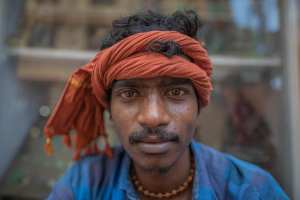
Photo Credit: Wari Ananda Om
Srikanda believes that “Without murti (statute of idols), there could be no puja, no temple, nowhere for people to come with their prayers and their problems.” (178). Perhaps, he’s right. However, the lives I witnessed both in and outside of the various temples we visited, revealed a people who value community and sacredness. According to Adele,
“It was time to return to the community, guiding and supporting the community with the inner wisdom that had been attained.” (52).
Throughout our pilgrimage, we were frequently invited into the community in various ways. Some stepped aside for us during darshan. Many fearlessly inquired as to where we were from. Mothers encouraged children to take photos with us. Many people requested “selfies”. Most were welcoming with smiles and greetings. Most made eye-contact. Meals were shared. Heads were bowed. Añjali Mudrā was offered. Om Namaḥ Śivāya and Namaste were uttered and exchanged.

Photo Credit: Wari Ananda Om
Despite being a third-world country, the people of India were gracious and generous with sharing their inner wisdom. Ultimately, I was afforded an opportunity not only to see Patanjali’s Yoga Sutras in action but also
“to see the sacred in the ordinary and the ordinary in the sacred.” (82).
Like Dalrymple’s text accomplishes, I, too, found the sacred in modern India among its people. With every gaze that was met, I found divineness without as well as within.
Om Namaḥ Śivāya🔱🙏
Works Cited:
Adele, Deborah. The Yamas and Niyamas: Exploring Yoga’s Ethical Practice. On-Word Bound Books: Duluth, 2009.
Dalrymple, William. Nine Lives: In Search of the Sacred in Modern India. Vintage Departures: New York, 2011.
 Apurva - Yoga with Jenn
[…] learned about myself on this journey – especially during the 2020-21 Pilgrimage to India (See Sacred India) and Living the 8-Limbs of Yoga. My practice has definitely shifted and evolved over the course […]