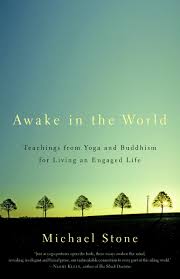
 Michael Stone’s text titled Awake in the World: Teachings from Yoga and Buddhism for Living an Engaged Life is a powerful read on the correlations between Buddhism and Yoga: mindfulness, simplicity, equanimity, and interdependence. Divided in 5 sections, he gradually reveals ways in which to deepen one’s practice. In essence, one’s practice extends beyond one’s mat in order to dissolve dualities and perhaps, bring more balance into today’s world.
There very foundation of mindfulness is the need to be present. Stone states, “If we are open to all of this decisively and without pause, we encounter the world as a part of it. This generates trust and reinforces the truth of being part of a much greater whole.” (25). In other words, we need to see ourselves as interconnected with the world around us in the present moment in order to trust and truly see reality as it is. He continues to suggest the effects of our intentions on reality, “This is no dream, there is no gift to open or heaven to which we must one day ascend; when we arrive in present experience, we come to see that the long carpet of reality is already unrolled.” (25). The constant need to “achieve” hinders our ability to remain present.
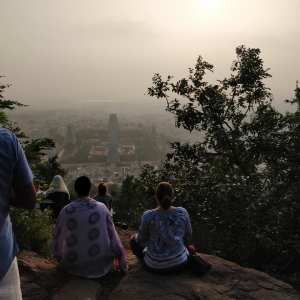
Mt. Aranchala overlooking Arunachalesvara Temple, Thiruvannamalai, Tamil Nadu, India (2019)
In order to be present requires both external and internal practices, “[p]ractice awakens the dormant and often invisible interiors of mind, body, and heart in order to establish a more tender, responsive, creative, and active self.” (13). The more one practices, the more it nurtures within us, it also radiates beyond us . . . beyond the four corners of our mat, beyond the four corners of the room as our “[i]nternal practices always flow back out into the world.” (58). It moves us not only toward self-acceptance and self-love, but accepting our part in a greater whole . . . as a part of the earth, not separate from it . . . interconnected (samādhi) (21, 25, 50, 89, 93). However, our practice must also address the dualities of effort and effortlessness, “[e]ffort must relax for intimacy to appear” (34). It becomes an opportunity to practice equanimity – “[e]quanimity (upeksā) is not a silent witnesses of our psychic lives but an opening toward what is.” (49).
One’s practice offers an opportunity of “seeing reality as a contingent and impermanent flow.” (108, 142). Indeed, it becomes an opportunity to break the habitual pattern that they have developed for “[i]f the practices are to be vibrant and challenging, they must also interrupt the habits . . . .” (105). This experience also serves to build “a trust in the complexity of life” – to “live as the water and function as the wave.” (87, 128). Indeed, reality is constantly in flux and ever changing but our reactions must remain constant.

Brihadeeswara Temple, Thanjavur, Tamil Nadu, India (2020)
In closing, Stone states,
“The point of ethical practice is that we are reaching out to listen rather than speak, to be touched rather than to touch, to be affected rather than to manipulate.” (146).
In order to do this, “[w]hen we are safe in our own bodies, we have a ground from which to step out into the world” – with practice, we are mentally prepared to step off of our mats and into the world (155).
Work Cited
Stone, Michael. Awake in the World: Teachings from Yoga and Buddhism for Living an Engaged Life. Shambala: Boston, 2011.
 Apurva - Yoga with Jenn