Michael S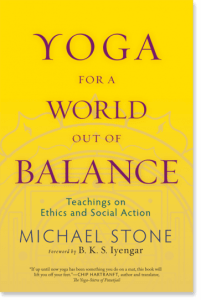 tone’s text titled Yoga for a World out of Balance: Teachings on Ethics and Social Action addresses the need for action, particularly the need for mindfulness and restraint (yamas) in a world full of unrestrained. His application of the Yamas from Pantanjali’s Yoga Sutras is an effective way in which to bring about much needed change, particularly with regards to the “habit energies evident in our own psychological, physiological, cultural, and ancestral patterns” – our own “ahaṇkāra” (I-maker) which in turn contributes to our Karma (7, 50).

Croatia Retreat (2018) Photo Credit: Sanjin Kastelan
According to Michael Stone, “the present moment begins in silence” and “everything is crafted out of silence.” (7, 125). Even in my own practice, I like to begin in stillness and end in stillness – bringing the practice full-circle much like the “life-death cycle of the breath” (34). This stillness is also an opportunity to ““sit with what is arising from moment to moment with acceptance and patience, steadiness and ease” – to go to a deeper level to reflect on what was revealed, released, and/or transformed to “bring about a fundamental shift in perception” (92-3, 116, 127). It is here that one’s true “narrative” arises free of the presuppositions of the old narrative – through an intimate and interior awareness of one’s authentic self and one’s interconnectedness with everything – after all, “[t]here is a whole universe even within one breath cycle” (128-129, 137, 142, 168). Afterall, to “sit in the midst of opposition creates the heat necessary for change” and to embrace “the energy of the moment rather than with our storytelling” (11, 78).
Much of our storytelling is rooted in our experiences, “Suffering is the foundation for happiness, anxiety the beginning of change. In fact, “[t]hat difficulty is also our potential for liberation.” (81). Indeed, through continued practice and attending various trainings, yoga became a “transformative” way of life for me. Beyond the postures, the practice is purely a “technique of moving the body into pure feeling and then dissolve the mind into that deep experience of feeling.” (11, 125). In fact, “the posture sequences open up different layers and movements of mind and body” (118). Throughout the asana practice, there are moments of “staying in the tension of opposites” as I will pause to notice “the patterns and disruptions of breath, the nervous system, the heart rate, the feeling tone” in the physical body – again noting my physical and emotional responses (77, 126, 138).

Croatia Retreat (2018) Photo Credit: Sanjin Kastelan
When I set aside my “ahaṇkāra” (the “I-maker” composition rooted in my traumatic experiences), I try not to focus on the end goal, but on the single, fleeting moment, and how I respond or react to each one physically and mentally – “it becomes a practice of finding within ourselves freedom from being caught in impermanent and limited situations.” (27, 99). Indeed, “the practice is to move beyond the story line and to stay, with acceptance, patience, and curiosity with the changing sensations that appear from moment to moment.” (139, 173). When we are able to “. . . cultivat[e] a kinder and more compassionate story to break down the tendency toward self-judgement,” we are better able to affect much needed change in the world around us (84).
Work Cited:
Stone, Michael. Yoga for a World out of Balance: Teachings on Ethics and Social Action. Shambala: Boulder, 2009.
 Apurva - Yoga with Jenn