I met Max Strom at the Midwest Yoga Conference back in 2011. He has a presence that is very grounding yet light hearted at the same time. In this particular pranayama workshop, I discovered new ways of breathing. I distinctly recall his guiding us through bahih and antah kumbhaka pranayama, and I was amazed with how air compresses in the lungs. After the workshop, I had gained a renewed sense of awareness.
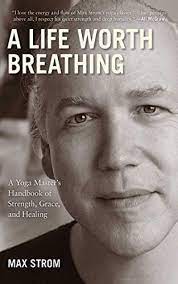
Strom’s book, A Life Worth Breathing: A Yoga Master’s Handbook of Strength, Grace, and Healing is very thorough and details how mindful breathing, along with the physical practice of yoga and meditation, can elevate our awareness. He begins by drawing the reader’s attention to the power of intention, “May we be a breath of life to the body of humankind” (28) thus eliminating the existence of duality and reminding the reader that we are not separate entities but part of a greater whole. He then warns against the ego-mind as being a “prisoner of itself” that is rooted in fear that reacts rather than acts to the unknown and aversions (29-30). However, through humility, “[t]his “not knowing” allows space for true knowing” – “the higher function of the heart within the heart” (36). Using the analogy of a magnifying glass, it is the power of self-discipline that magnifies and burns away obstacles and leads to personal transformation (36-37).
Strom then details the three pillars: Mind, Emotions, and Body. As if awakening from a dream, breath work is like turning on a light from the dark recesses of our inner being (47). When synced with movement, one is able to slow down the thoughts and to dissolve the ego-mind. To feel the energy within opens one’s heart and feelings of immense love, thus illuminating the darkness within (48). The same holds true with meditation which leads one to “remember and have access to wisdom long buried” as the chatter of the mind quiets and the heart opens (52). Pranayama practice also serves to “harmonize” the somatic, autonomic, and sympathetic nervous systems (53-54).
The second pillar, Emotions, Strom reminds the reader that “while circumstances are often beyond our control, our emotions are our own. The practice of choosing your state of mind is the beginning of happiness.” (60). In fact, one’s reactions are a reflection of one’s own emotions, particularly with regards to the feelings of intolerance and anger (68). Strom’s words “ When we grant mercy to others, we grant mercy to ourselves.” (75) in particular resonated with me; having forgiven my abuser, I was more at peace and able to move on from adolescence into adulthood; I was also able to find gratitude knowing that I was on the other side of the darkness and in those times of turmoil, I discovered my inner strength and courage. Indeed, gratitude is the parent of all virtues:
Within your gratitude is one of your greatest powers, for only when you find gratitude do you begin to be liberated. Gratitude humbles you, and the humility enables you to forgive. Forgiveness gives birth to sympathy and love itself, and in love we are liberated . . . let us remember our most profound gratitude, and forgive those who have forgotten theirs.”
(Strom, 84)
With regards to the third Pillar, the Body, residuals of my developmental trauma and losses are still evident in my physical practice, “opening the chest is the hardest part of one’s yoga practice because it is in the chest that we keep our grief and our old memories” (106). I recognize these residuals and offer them love and compassion without any judgment. I release it even if it’s only for that breath, for each subsequent release becomes a little easier. This is the part of the practice that extends beyond my yoga mat; I find myself doing the same inner practice throughout my day. As a result, I have become “more at ease, storing less negative anxiety and tension” (123). I’ve also noted that calmer people and places resonate with me, thus indicating a more harmonized nervous system (125).
Strom then outlines where we hold emotions in the body as well as the asanas that will address those areas, followed by advice on how to get started. The complete integration of the pillars is through the breath, “[t]he highest Self sets your intention through the mind. The breath transmits your intention into every cell of your body.” (148). He then suggests a code of conduct, referred to as the “Five Causes” to practice: gratitude, forgiveness, kindness and honesty, humility, and ethics (154-155). He concludes with principles of action that remind the reader of how one’s self-awareness also affects one’s external-awareness by addressing conscience, awareness of time, competition and power, money, and activism without anger. Indeed, “Nearly all of the world’s external problems are symptoms of internal problems, inside of you and me.” (191). Now more than ever, “we need to take our principles of living beyond ourselves to help others on their path, whether individually or collective.”
Work Cited:
Strom, Max. A Life Worth Breathing: A Yoga Master’s Handbook of Strength, Grace, and Healing. Skyhorse, 2012.
 Apurva - Yoga with Jenn