Ram Dass’ Polishing the Mirror: How to Live from your Spiritual Heart is a personal narrative and instruction manual for those interested in deepening their practice on a spiritual level. Through the use of personal narrative, Dass uses a combination of insight, humor, stories, and guidance from his own practices to illuminate a deeper level of consciousness: “The spiritual journey is not about acquiring something outside of yourself. Rather, you are penetrating the layers and veils to return to the deepest truth of your own being.” (6). By sharing his own journey of “polishing the mirror”, he reveals how one’s authentic being is deeply seated within one’s heart: “Consciousness itself is a hall of mirrors. The key quality of the human soul is the ability to reflect on its own existence. Self-reflection, introspection, self-inquiry – whatever we call it – takes us through many layers of the onions of our inner being, . . . “ (170).
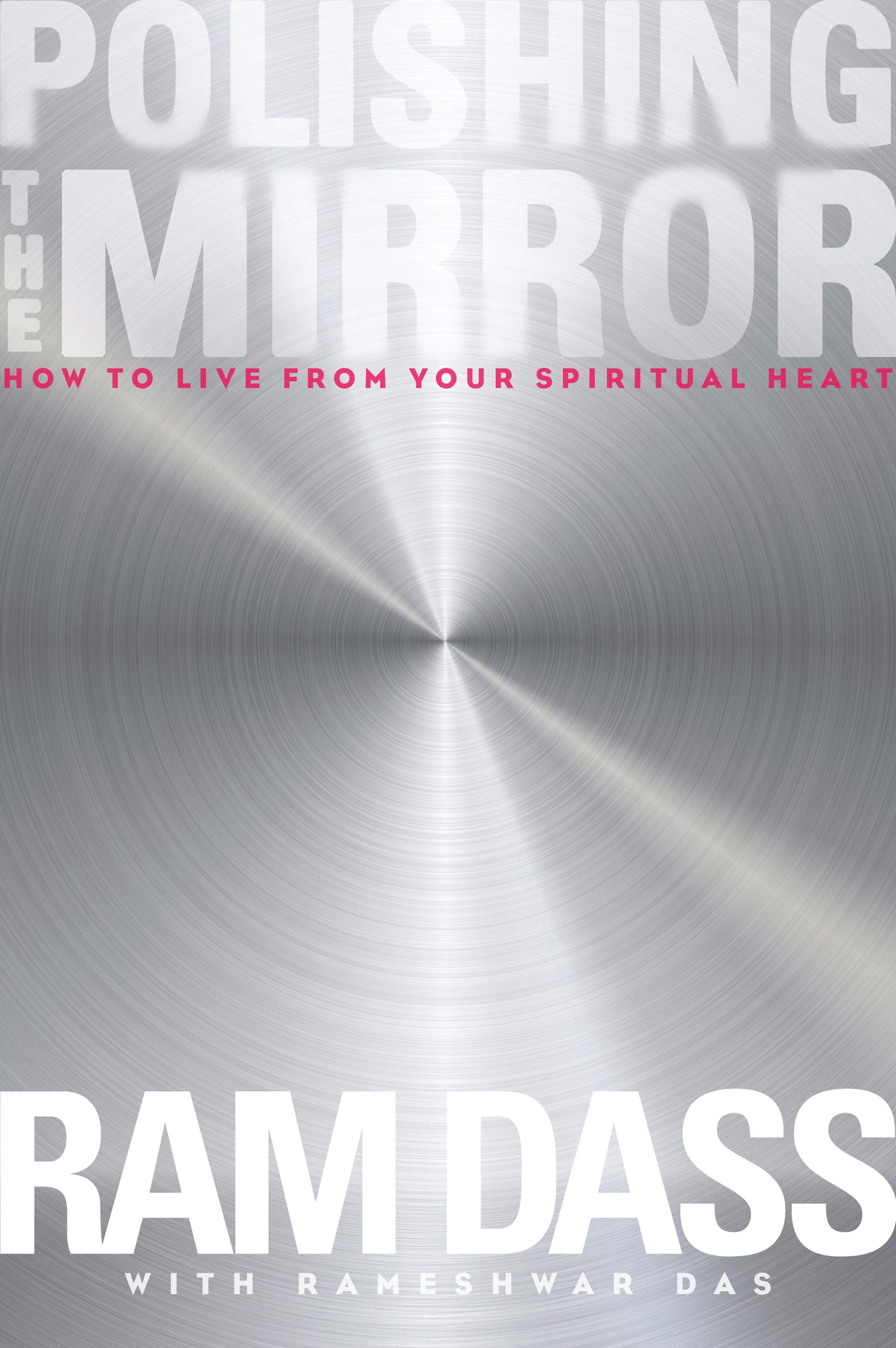
According to Dass, “Bhakti is the path of the spiritual heart, using our human emotions to forge the connection between the human and the divine.” (13). He also emphasizes love is a state of being: “. . . love isn’t possessive. We can’t collect it. We can only become it” (16), and these teachings can be found anywhere, “You don’t have to rush off to India, because the guru and the teaching are always right where you are, right here, right now.” (20). It is a process that requires our faith to reveal “the impurities and imperfections of our individuality that keep us from becoming one” (22). Additionally, karma is our dharma, “As a conscious being, you do all you can to live in your soul and to create space for others to be in their soul too.” (34). This requires our bearing witness as a neutral observer to our own attachments. According to Dass, “everything we notice in the universe is a reflection of our attachments.” (36). Thus, “living a spiritual life is a strategy for working on yourself for the benefit of all beings.” (44). This witnessing of our feelings and emotions allows us to simply observe, acknowledge, permit it to be, so we can eventually release them. In turn, “you also become a mirror for others to find their souls.” (119).
The account of “hanging out with blue Krishna and driving [slowly] along the New York Thruway” in a black limousine converted into a camper was hilarious. The image of Dass with one hand on the wheel and mala beads in the other while singing to Krishna had to have been a sight to the state trooper who eventually pulled him over. The inner monologue of Dass, “Wouldn’t Krishna come as a state trooper? Christ came as a carpenter” makes one consider the possibility of the divine in all living beings (57).
Dass continues his narrative reflecting on the aging and dealing with change, “Old age trains you for change – change in your body, change in memory, chance in your relationships, change in energy, chance in your family and social role – all leading to death” (65). I, myself, have noticed these gradual changes with each passing year. Now at the age of 51, my priorities have changed, my circle of friends has grown smaller, and I am more committed to my yoga practice on and off my mat. Maybe I have become “irrelevant” for some, but it has given me more time to do inner work and to shift from “doing” to “being” (73).
His chapters dealing with death and dying really resonated with me. I am no stranger to hospitals, acute care facilities, and nursing homes. I have even assisted in hospice care for quite a few friends and relatives. As Dass recounts, I, too, have witnessed the “deception” given to those who are dying and to the caretakers as a means of easing the fear, guilt, pain and suffering (85). Personally, I was honored to be present for the transition of an uncle, my husband’s grandfather, my father, my mother, and my beloved felines, Smokey and Bandit. It is the ultimate offering one can give by being present and giving permission to let go; it is the “most exquisite manifestation of service” (89).
Dass’ description of dying reminded me of a collection of poems written by Emily Dickenson that explored death and dying. One in particular explores the senses and how they become confused and blended (synesthesia):
I heard a Fly buzz – when I died –
The Stillness in the Room
Was like the Stillness in the Air –
Between the Heaves of Storm –
The Eyes around – had wrung them dry –
And Breaths were gathering firm
For that last Onset – when the King
Be witnessed – in the Room –
I willed my Keepsakes – Signed away
What portion of me be
Assignable – and then it was
There interposed a Fly –
With Blue – uncertain – stumbling Buzz –
Between the light – and me –
And then the Windows failed – and then
I could not see to see –
The last stanza reveals the synesthesia of the senses: “blue” being a color that is seen; “stumbling” being a sensation that is felt; “buzz” being a sound that is heard. Dass’s description of dying reveals a process associated with the elements: “As the earth element leaves, your body will feel heavy. As the water element leaves, you will feel dryness. As the fire element leaves, you may feel cold. As the air element leaves, your out-breath will be longer than your in-breath. The signs are now here. Don’t get lost in the details. Let your awareness go free.” (91).
With death comes suffering. Recounting the 4-Noble Truths of Buddhism, Dass emphasizes that attachments are the “clinging of mind – to attractions and aversions” that create a false sense of the self. To demonstrate how suffering can be eased, Dass uses his suffering from a stroke as an example: “identify with being a witness of pain. Physical pain is in the body, and I am not my body.” (102). By shifting our perspective about suffering, it can be viewed as a “fire that purifies” or possibly “the teaching you need in the moment.” (108). It is through these experiences that we can become compassion: “You don’t have compassion – you are compassion. True compassion goes beyond empathy to being with the experience of another.” (109).
Despite the passing of various loved ones, the one that hit me the most was the passing of my dearly beloved father. He was the epitome of unconditional love and compassion. Throughout my life, he was always there for me; he encouraged me in ways that my mother did not; he loved me in ways that my mother was unable to. What made his passing particularly difficult was the fact that my son, then 2 years of age, would grow up without truly knowing him. As a means to cope with his passing, I came across a Sushila Blackman’s book titled Graceful Exits: How Great Beings Die; reading through this compilation of death stories from Hindu, Tibetan, Buddhist, and Zen masters, I found some reassurance and solace in the loss. After reading this particular chapter in Polishing the Mirror, I was reminded of Ramana Maharshi from our visit to the Sri Ramanasramam in Thiruvannamalai, India; I consulted Graceful Exits to find an account of his passing:

The end came on April 14, 1950. That evening the sage gave darshan to all the devotees in the ashram. They sat singing Ramana’s hymn to Arunacala, the name of the holy mountain the sage so loved. He asked his attendants to help him sit up, and opened his luminous and gracious eyes for a brief while. There was a smile, a tear of bliss trickled down from the outer corner of one of his eyes, and at 8:47 pm his breathing stopped. There was no struggle, no spasm, none of the signs of death. At that very moment, a comet moved slowly across the sky, passed over the summit of the holy hill, Arunacala, and disappeared behind it.
(Blackman, 56).
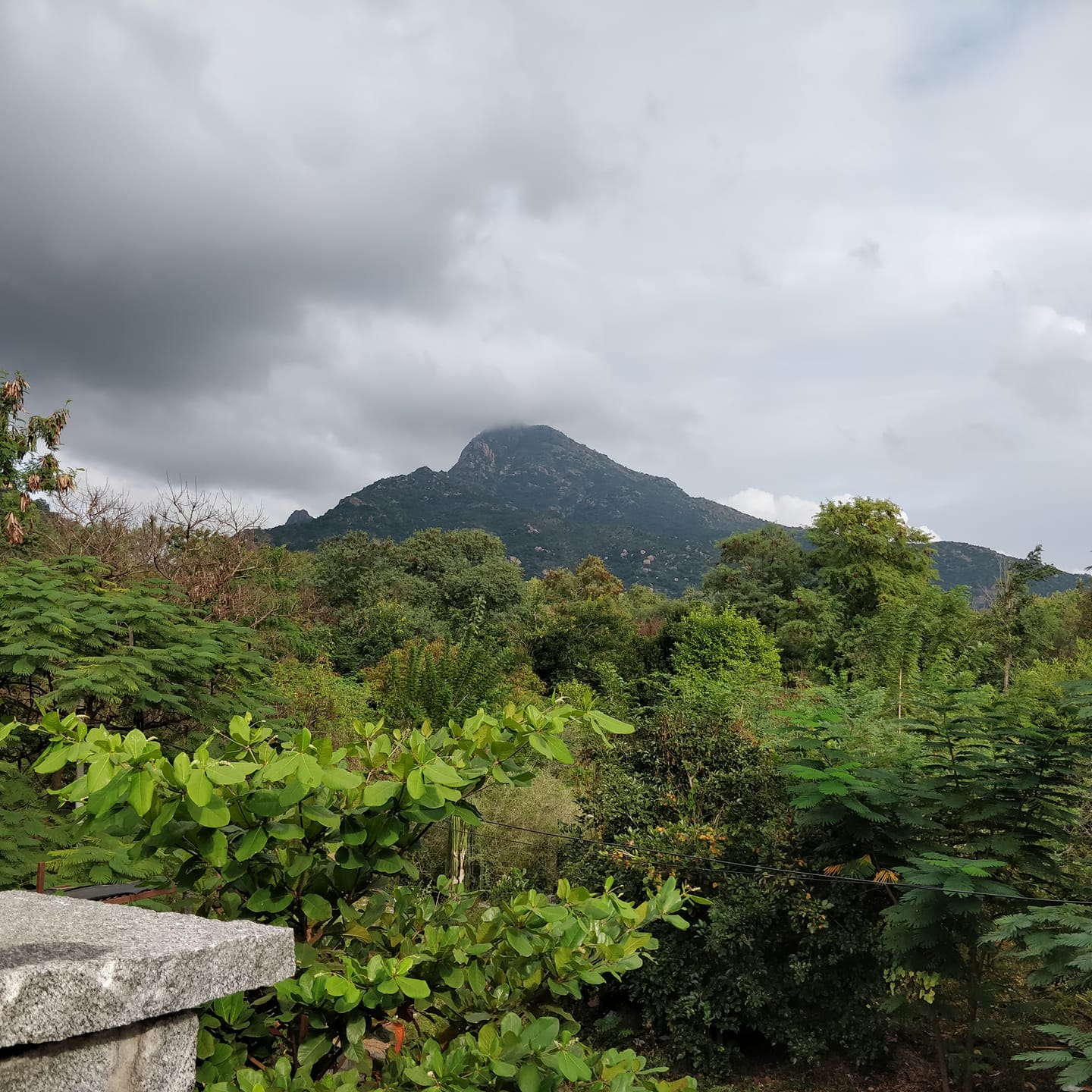
— in Tiruvannamalai.
Indeed, Sri Ramanasramam demonstrated supreme compassion not only towards others, but especially towards himself. In his own words, “There is no need for alarm. The body is itself a disease. Let it have its natural way.”
Dass concludes his narrative with various forms in which to “polish one’s own mirror” through practicing daily mediation, honoring silence, expressing gratitude, participating in Kirtan, recognizing realized beings, and listening to one’s intuition.
Works Cited:
Blackman, Sushila. Graceful Exits: How Great Beings Die. Shambala, 2005.
Dass, Ram. Polishing the Mirror: How to Live from Your Spiritual Heart. Sounds True, 2014.
Dickinson, Emily. “I heard a Fly buss – when I died -” (591). Poetry Foundation.
 Apurva - Yoga with Jenn