Final Reflection

Posted: January 19, 2022 in YTT Reflections

This 300-hour yoga teacher training began at the Santosha retreat in Mexico in 2016; reflecting on the past 5+ years is a daunting task as so much has occurred and so much has been learned. The past 4+ years are a blur courtesy of my previous profession entailing 70+ hour work week, thus only having the time and energy to tend to the coursework over winter and summer breaks, as well as extended weekends. Despite these limitations, I am grateful for these pauses as they provided me the time necessary to truly allow the various trainings to marinate and manifest in my own practice.

Santosha Retreat, November 28, 2016
Cabo San Lucas, Mexico

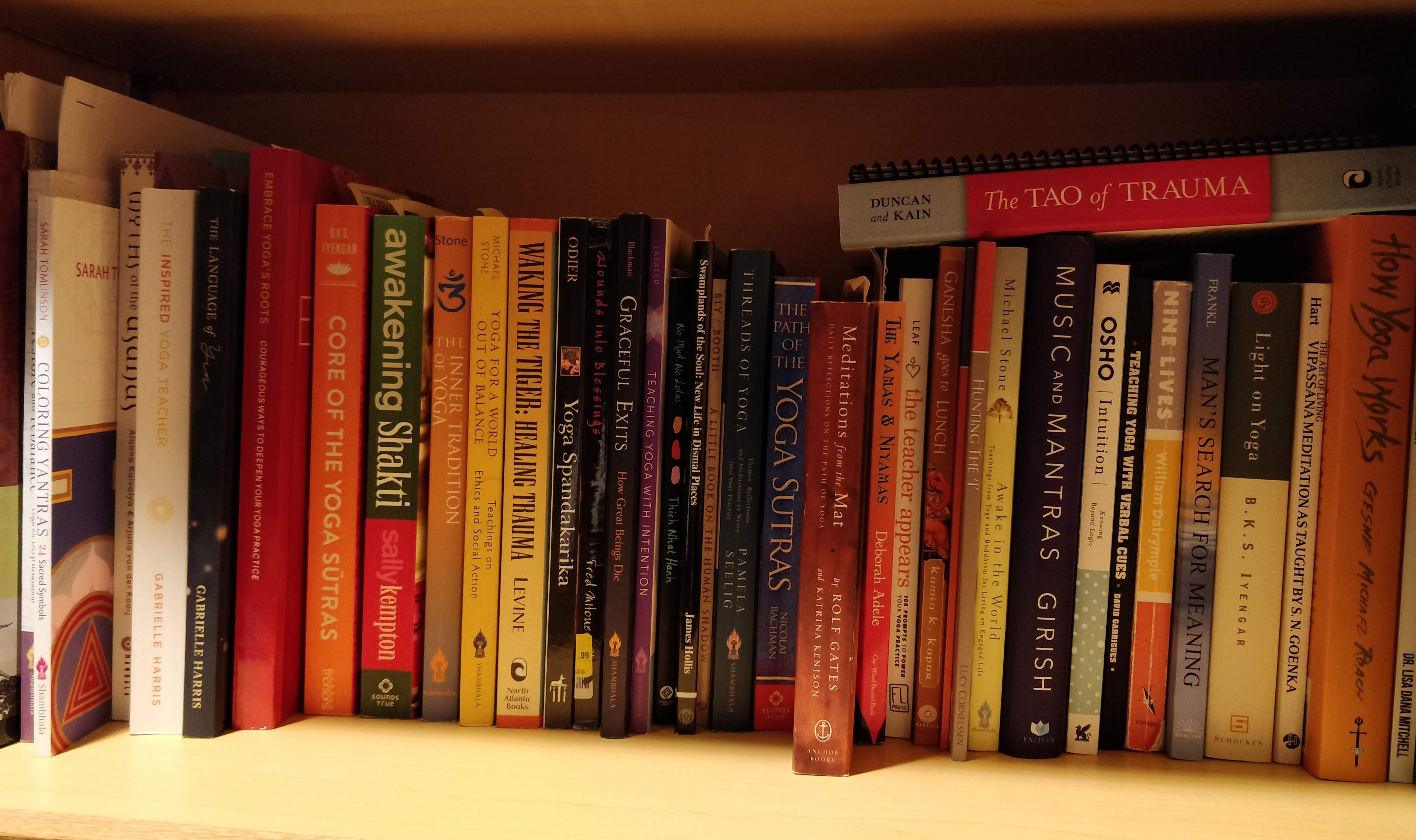
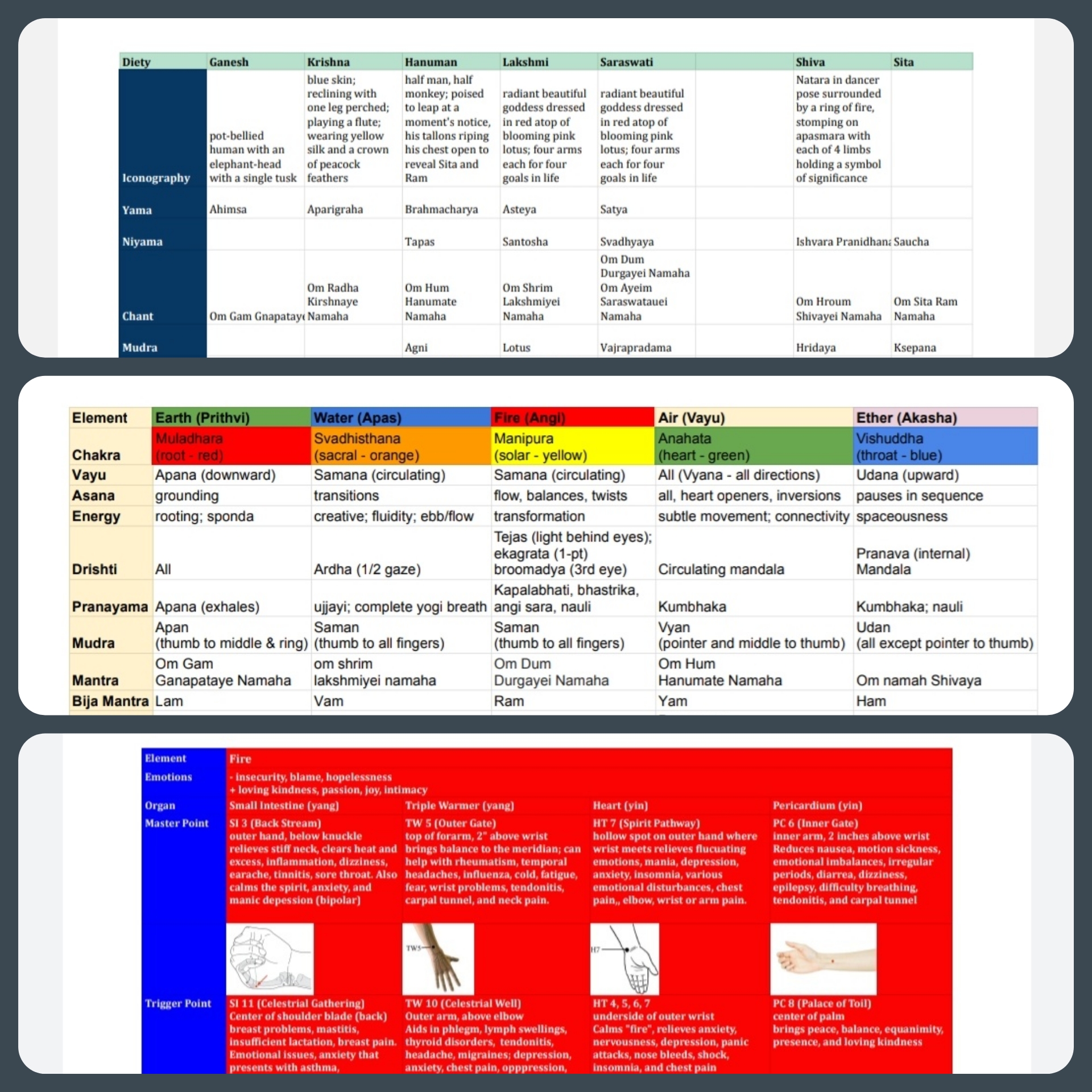
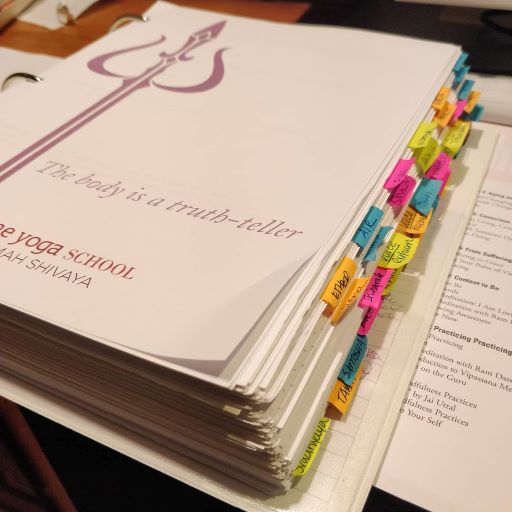
Each training offered truly unique experiences, materials of which are housed in a 4” binder along with my notes, and an entire shelf in my office devoted to course readings. To assist in my synthesizing this wealth of information, I began creating spreadsheets not only to collect, but to categorize and organize the information – often employing color-coding. As a visual learner, these charts were instrumental in helping me to conceptualize the various readings and voluminous amounts of information provided in the training sessions, particularly with regards to the various elements associated with this ancient practice. 

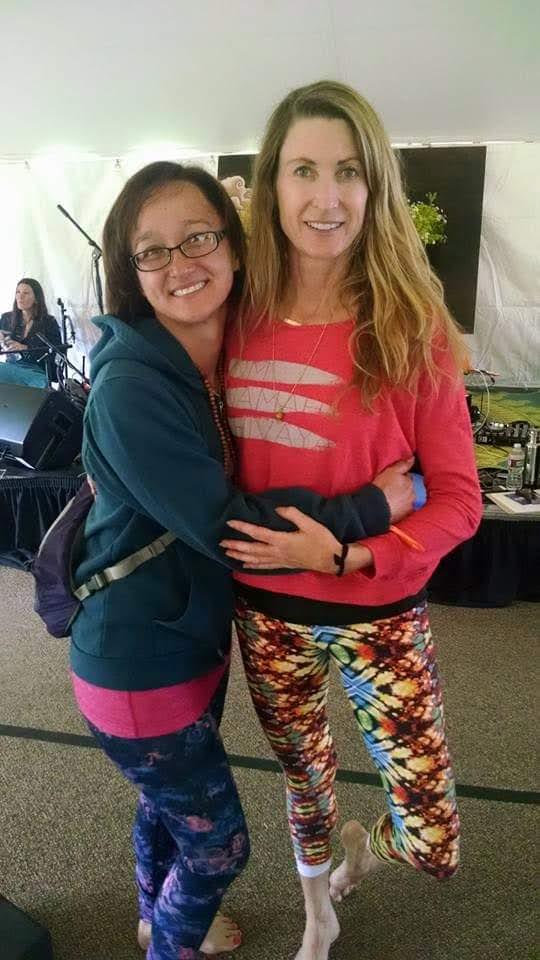
I remember asking Janet many years ago at a Hanuman Festival if there was a teacher or a studio in the Chicagoland area with similar offerings I’ve experienced with her. Her response: “You’ll have to create it.” I knew she wasn’t kidding, but the task seemed impossible. So, I focused on the path and let go of the goal, per se. I began incorporating a few elements and rituals into my own practice which then rippled into my teachings. Further along the path with a deeper connection to the practice, a shift began to occur: students became more interested in delving deeper.

Hanuman Festival, 2015

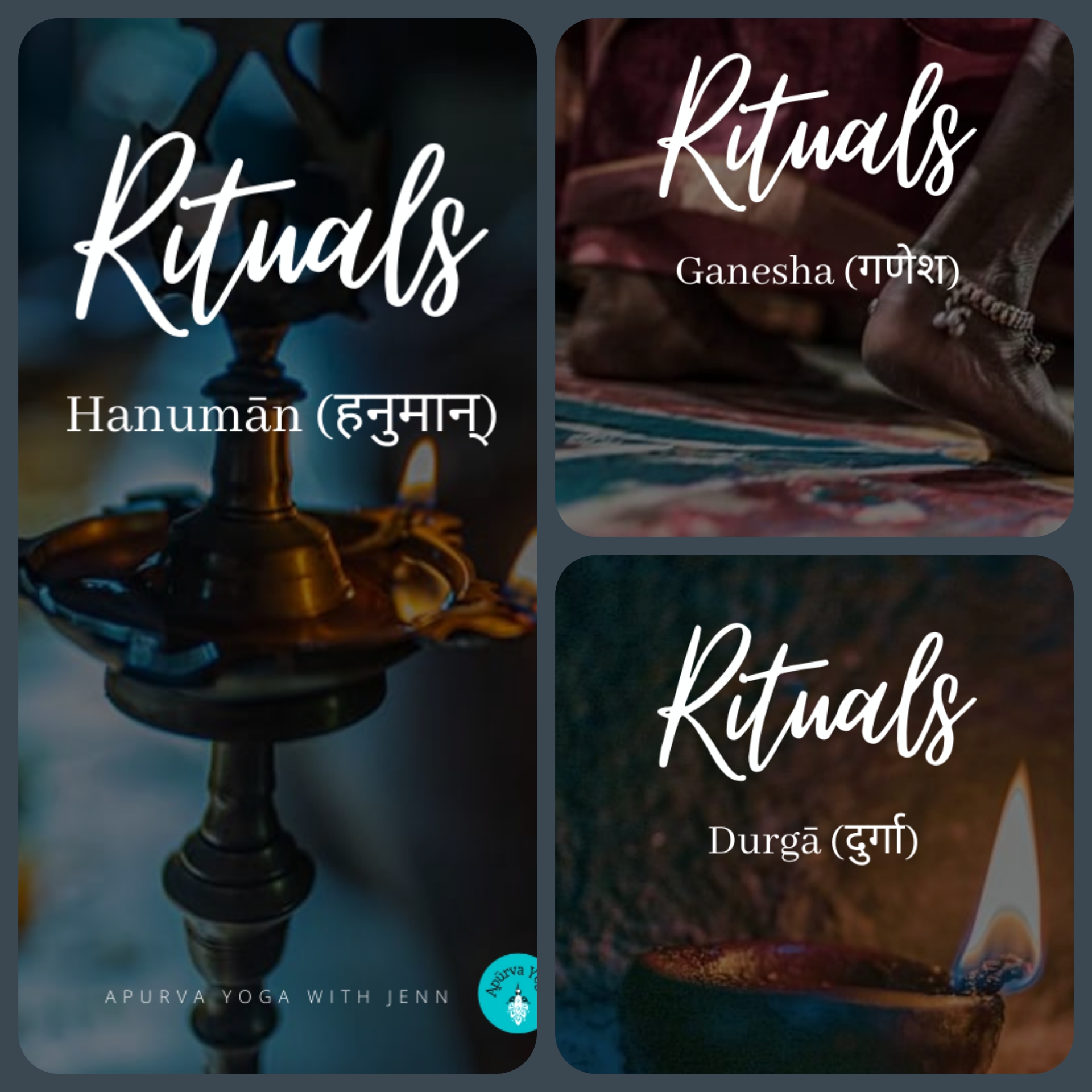
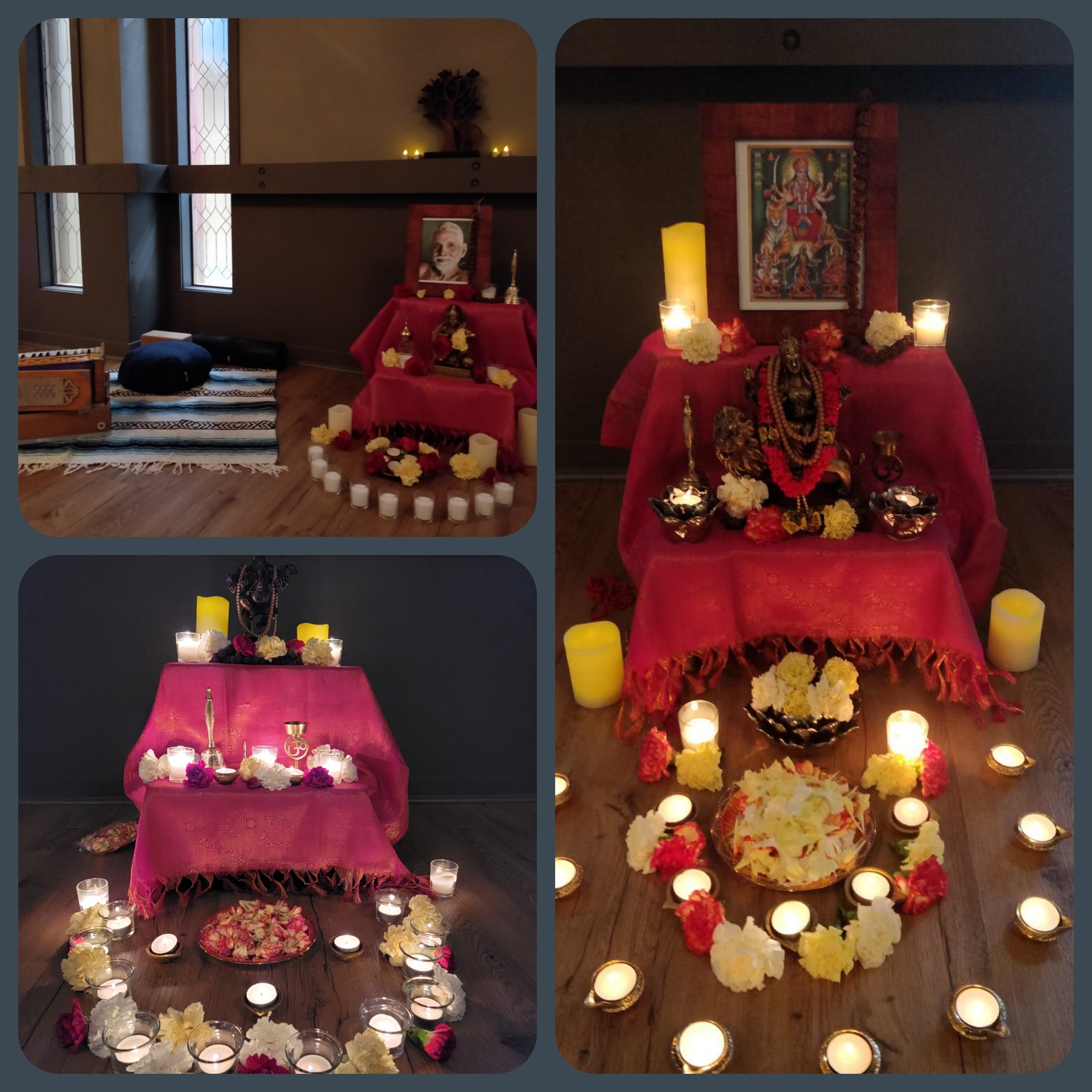
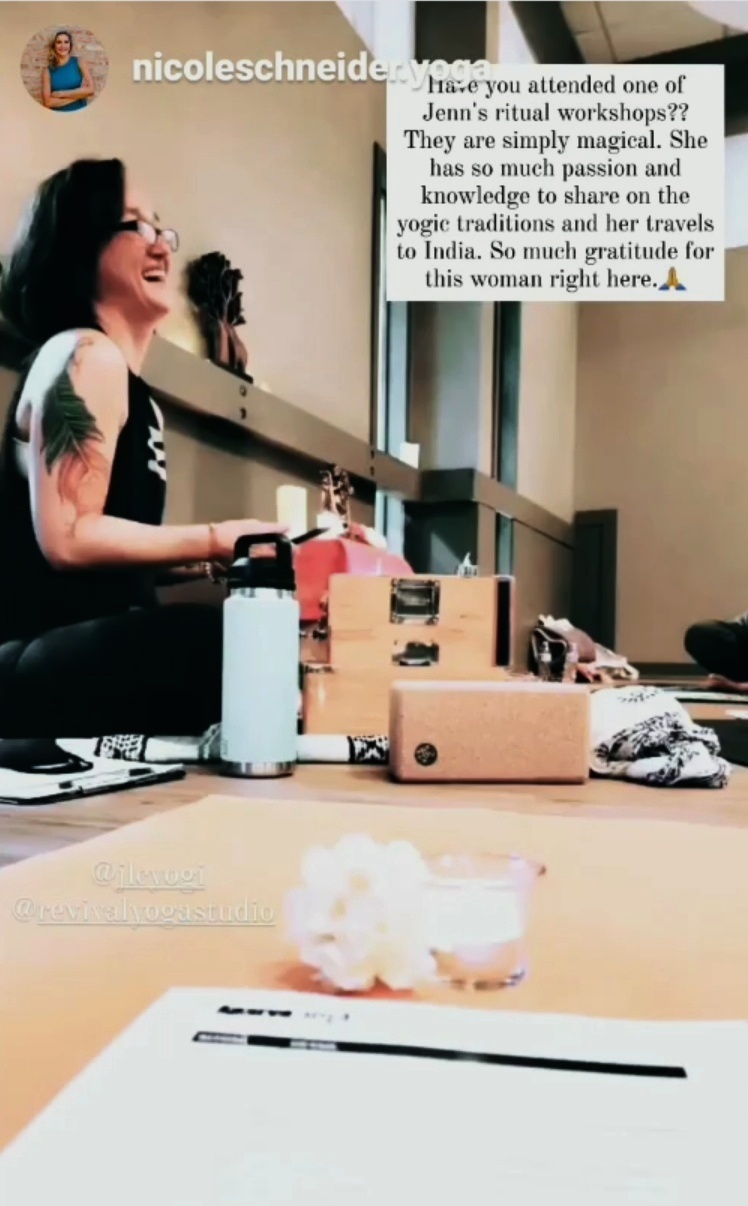
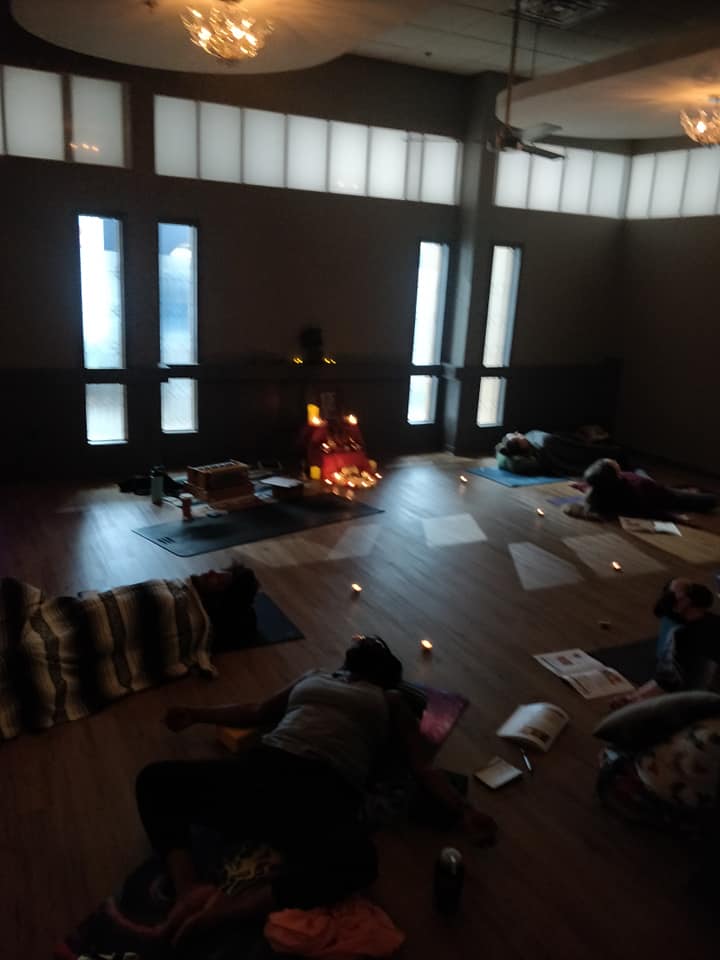
Years later, the aforementioned spreadsheets gave birth to a new offering in the form of a workshop titled “Rituals”. Setting aside a lifetime of fears and doubts, I sought to create a unique experience: a 2-hour workshop that incorporates many of the elements and rituals associated with a particular deity. Having completed Hanuman, Ganesha, and Durga, students are now requesting monthly offerings; fellow teachers are suggesting that these offerings should be included in future YTTs (See Conceptualizations for charts and Rituals Student Manuals). Indeed, what seemed impossible many years ago has now manifested into something magical.

Manual Covers
Altars for Hanuman, Ganesha, and Durga
IG Post by Nicole Schneider
Ganesha, December 3, 2021

As stated in my 90-Day Sadhana reflection, there is much that I have learned about myself on this journey – especially during the 2020-21 Pilgrimage to India and the 8-Limbs training (See Sacred India and Living the 8-Limbs of Yoga).  My practice has definitely shifted and evolved over the course of this YTT, and it will continue to do so. For now, I am content and so very honored to have been included. While my Svādhyāya is far from over, I will continue on this path, and I will carry forward all that has been offered to me . . . love, compassion, grace, and gratitude. 

Photo Credit: Wari Om

Respectfully submitted with heartfelt love and immense gratitude.

Om Namah Shivaya

90-Day Sadhana

Posted: January 18, 2022 in YTT Reflections
Photo Credit: Brian Christian Adam

My daily sadhana practice includes ayurvedic morning ritual (cleansing teeth, tongue and face, lemon water) followed by dharma reading with coffee. I then perform Aarti (Hanuman, Ganesha, Durga), meditation with mantra, pranayama with mudra, asana practice, and close with Bhakti (practicing on my harmonium). During this 90-Day Sadhana, I also participated in a 40-Day Hanuman Chalisa Sadhana with Ram Chandra Das and Govind Das. Each day was devoted to a line(s) of the Hanuman Chalisa. The daily session began with aarti, full recitation of the Chalisa, translation and recitation of the day’s assigned line(s), dharma regarding the line(s), followed by bhakti of the full Chalisa

After retiring from public education last year in June, I returned to the Ashtanga practice. The longer holds during each posture (5 breaths each) resulted in more turning in and slowing down in my asana practice. I also began pausing between transitions; pausing to feel and pausing to notice. Additionally, I began exploring the Shakit energy more and incorporating it into my daily practice: beginning sequences on the left (ida) side, longer holds on the left side (especially during yin), and more grounding of the front body. What began to surface was the idea of tapping into Trantric perspective described in Sally Kempton’s Awakening Shakti:

“. . . all our biological activity is inherently feminine. The power behind the breath, . . . our heartbeat, the energy that fires our muscles, and the impulse behind thoughts.” (12)

Kempton, Sally. Awakening Shakti: Transformative Power of the Goddesses of Yoga. Sounds True, 2013.
Photo Credit: Brian Christian Adam

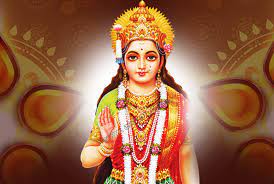
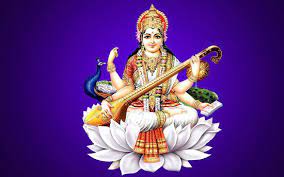
I envision the human digestive process as another form of Shakti – an elaborate process that requires no thought but just is; a process attuned to making use of the good and eliminating what is no longer needed or in excess. The digestive process is not limited to what we literally consume, but also everything that we take in from our other senses, as well as everything that has been passed down from those who came before us. But what surprised me the most was the profound realization (a manifestation of Saraswati) that the Shakti energy is about “being” rather than “doing.” These dramatic pauses in my practice became opportunities for me to simply be, as I am in that very moment, in that very breath; opportunities to bear witness without any judgment, expectation, or reaction; opportunities to sit in the fire of self-acceptance and healing.

Resistance continues to arise in my practice with regards to inversions and backbends. This resistance manifests from deeply rooted fears and feelings of inadequacy stemming from childhood traumas. However, over the course of the Sadhana, I recognize the resistance and attempt to set aside the negative emotions of the past. While I might not succeed in a particular inversion or backbend, I continue to focus on the path rather than the goal. 

What has come with ease in my practice is taking more opportunities to slow down, to feel, as well as the idea of “letting go” – even if it’s only for that moment; only for that breath. Releasing longer holds enables me to relish in the relief that courses through me and reminds me of how good it feels to simply let go – letting go of negative thoughts, emotions, or energy.

Photo Credit: Brian Christian Adam

My practice definitely rippled into my teachings. In fact, my class offerings shifted from Vinyasa to Slowburn and Yin. I never really considered myself a “yin” teacher; I was always  a vinyasa-kind-of-gal who loved the fast-pace, tricky transitions, and heat. However, I’ve noticed that I’ve slowed down. Maybe it is due to my getting older; perhaps, I’m done running and avoiding. Since these slower practices have truly resonated with me, my offerings have become more authentic, thus resonating with my students. Perhaps this need for slowing down and pausing is a direct result of the global pandemic that has created much fear and anxiety. These opportunities to slow down have been well-received in my class offerings.

Rituals, 1/16/2022

While there are various ways in which I continue to integrate my daily practice, it is impossible to incorporate everything in a one-hour offering, I always set an intention and allow whatever to be to simply manifest. Oftentimes, I will incorporate my daily dharma reading as well as a particular ritual that resonates with the reading (pranayama, mudra, chakra, and/or niyama, yama). Janet’s question: “What are you up to?” is always in the forefront of my mind before each and every offering. 

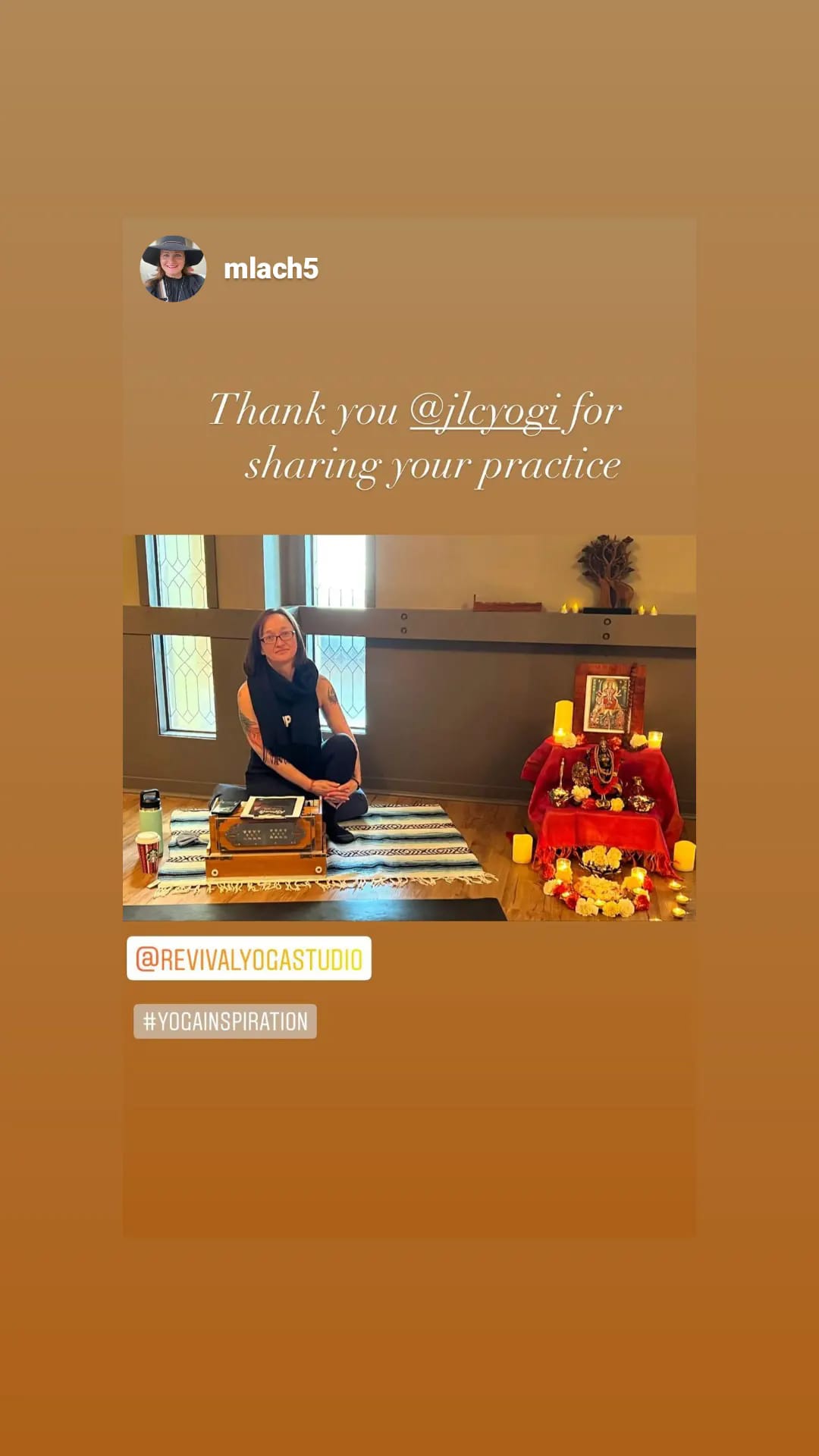
As a result of my 90-day sadhana, I have created a unique offering known as “Rituals”. This 2-hour satsang has been well-attended as more students have expressed an interest in delving deeper into the practice. Over the course of the workshop, I incorporate various elements of the practice associated with a particular deity: traditional opening chant; mantra with mudra; iconography, role, embodiment, and dharma; overview of and application to the corresponding Element, Energy, Vayu, Kosha, Chakra, and Nadis; overview of and application to 8-Limbs; pranayama practice; intentional, grounded movement; meridian work (Yin and Restorative postures); and closing with bhakti. 

IG Post by Melissa Lach

In closing, the journey is far from over. I will continue to hold myself with love, compassion, and forgiveness so that I can offer the same to all those around me.

Awaking Shakti

Posted: December 30, 2021 in Book Reviews

Sally Kempton’s Awakening Shakti: The Transformative Power of the Goddesses of Yoga serves to provide a deeper understanding of and appreciation for the various goddesses associated with Tantric Narrative. While familiar with each of the goddesses covered due to the dharma talks during various trainings with Janet, this text not only elaborated on those teachings but also illuminated each goddess in form and function. 

With each chapter dedicated to a goddess, Kempton details the stories associated with her, how to approach the goddess, how to ask for help, how the goddess is revealed, characteristics of the goddess (including the shadow side), and concludes with mantras. What was particularly illuminating was Kempton’s application of the goddess in everyday life involving ordinary people; thus bringing into view each goddess through a contemporary lens that offers a very modern and realistic perspective. In fact, on numerous occasions while reading, I found myself reflecting on situations and events that revealed my own connections with each deity. 

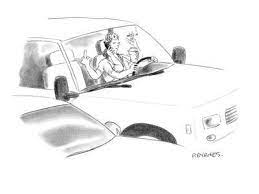
Kempton’s description of a cartoon she had seen in the New Yorker featuring Durga made me laugh, but on the other hand, it also really resonated with me. I had to find it!

As a mother and retired educator, the personality of Durga is evident in me, “When you feel drawn to this goddess, it usually indicates one of two things: either you need an infusion of Durga-like strength, or you carry the Durga archetype as part of your personality . . . .  warrior-style leadership.” (68). Juggling a high pressure job and domestic life, I was the epitome of a multi-tasker (oftentimes to my own detriment). By day, I was a high school teacher with 2-3 different courses to plan, teaching 5-6 periods a day, and attempting to empower classrooms full of struggling, impoverished adolescents. By night, I was a mother and wife – two roles of which I am very protective. The shadow side of Durga is her need for “control to the level of micromanagement”, but this applies only to myself as it manifests in my OCD as a result of the “relentless inner critic” highlighting every one of my faults and flaws (72). According to Kempton, “[o]ne way to get a felt sense of the Durga Shakti is to remember a moment when you recognized, from the deepest place inside of you, that something was wrong, that it had to change.” (73). This moment for me was when my son was 2-years old: my father had passed from Non Hodgkin’s Lymphoma associated with Agent Orange exposure in Vietnam; my mother was undergoing chemotherapy for breast cancer; and my son had entered the “terrible twos”. As a result of a particular moment when my frustrations and anger were beyond my control, I saw myself turning into my mother. It scared me. I had to make a change. Thus, I found refuge in a local yoga studio and discovered a path towards revealing and healing.

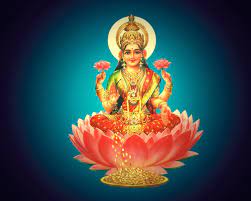
Lakshmi’s qualities of “generosity, loving-kindness, carefulness, unselfishness, gratitude . . . discipline, cleanliness, and order” also resonate with me to the point of imbalance (106-107). I will often make sacrifices for others to the detriment of my own time, resources, energy, etc. However, since retiring from public education, I’ve been able to find more balance in my daily life (to include keeping a tighter budget). While reading the chapter on Lakshmi, I took pause, “In India, the yearly Lakshmi festival begins with a thorough house cleaning. Everything in the house is scrubbed and polished, and only when the dust and first have been removed is the household considered ready to welcome Lakshmi.” (109). Before reading this particular chapter, I had taken advantage of my husband, son, and dog being gone for a week; to create balance, I focused on deep cleaning and polishing one room of the house at a time over the course of the week. Coincidence? Or prophetic?

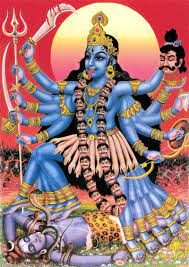
Kempton’s exercise “Dialoguing with Kali” outlines writing down questions for Kali with your dominant hand (for me, right) and then writing the answers with your nondominant hand. This immediately reminded me of a similar application to my own practice. Over the past few years, Ida and Pingala nadis have really transformed my practice and my teachings. I began with longer holds on the left side during yin and restorative classes; and a couple of weeks ago, I began my cueing the left side first as opposed to the right – much to the confusion of all. Kali also surfaced in a recent event at a local Starbucks. After a yoga class, a long time friend and I decided to stop for a coffee. While we were conversing and regaling in laughter, another patron began yelling at us, “Can you quiet down. No one here is interested.” Kali’s fire indeed, “[Sometimes] the way through Kali’s fire is utter surrender . . . sometimes, it’s quite simply our ability to love her even in her terrible form.” (140). While my friend wanted to yell back, I discouraged him by simply saying, “The holidays are tough for some people.” 

In Part One: Receiving the Energy of Parvati, I was reminded of a memorable moment during aarti at our New Year’s Eve Puja in India that, even now, brings tears to my eyes. After a round of Bhakti, Janet circulated to perform tilaka (the application of the kumkum powder). When she knelt down before me, and our eyes met, I was overcome with emotion, “Parvati’s strong and tender love-light now illuminates your heart, purifying it of wounds and blocks, dispelling the armor that you’ve erected around it. As your heart opens and releases its blocks, tears might come. Let them flow.” (162). During this dramatic pause in time and space, I acknowledged the divineness that resides deep within her as well as within myself.

According to Kempton, “[w]hen words flow easily, when ideas come up out of nowhere, when you say something so powerful and profound that it surprises even you, you are experiencing Saraswati” (178). This happens often as I guide classes to create sacred space by which to begin or to end one’s practice. The wealth of knowledge I have gained since beginning my training with Janet has been held, permeated my heart and mind to the point that it has become a part of me and has led me to express things in my own words in unique ways (187). I have experienced her “creative flow through language, speech, and sound” on numerous occasions, particularly in mantra or Bhakti (179). Singing has always come naturally to me. I remember the first class I ever took with Janet at the Midwest Yoga Conference; I never felt more alive and empowered through the Bhakti she offered. Like Saraswati, I enjoy “solving intellectual and artistic problems, discovering connections and new paradigms” (179). As a public educator, students always were amazed at how I was able to empower them by asking “the right question – the question that elicits a new way of thinking or a different way to look at a problem.” (180). Like Saraswati, I am “a proof-reader, a timekeeper, a perfectionist.” (191). I also connect with her in what Kempton states is “arousal from below.” (195).  All through college, writing was the “process of regurgitating it onto paper, resisting the urge to edit . . . Later to . . . sculpt the mess of words” into a well-written essay (192). After all the writing and research, the moment I walked away, the inspiration arrives (195). As for her shadow side, this too rings true for me as “negative self-talk all linger in the heart . . . the brain is wired to remember the negative much more easily than the positive.” (182). But I am continuing the work necessary to change the narrative. 

While additional deities were also included in this text, the foregoing were the ones that truly resonated with me in one way or another. I would definitely recommend it to those interested in delving deeper into Tantra.

Work Cited:

Kempton, Sally. Awakening Shakti: The Transformative Power of the Goddesses of Yoga. Sounds True, 2013.

A Life Worth Breathing

Posted: December 30, 2021 in Book Reviews

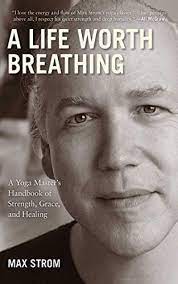
I met Max Strom at the Midwest Yoga Conference back in 2011. He has a presence that is very grounding yet light hearted at the same time. In this particular pranayama workshop, I discovered new ways of breathing. I distinctly recall his guiding us through bahih and antah kumbhaka pranayama, and I was amazed with how air compresses in the lungs. After the workshop, I had gained a renewed sense of awareness.

Strom’s book, A Life Worth Breathing: A Yoga Master’s Handbook of Strength, Grace, and Healing is very thorough and details how mindful breathing, along with the physical practice of yoga and meditation, can elevate our awareness. He begins by drawing the reader’s attention to the power of intention, “May we be a breath of life to the body of humankind” (28) thus eliminating the existence of duality and reminding the reader that we are not separate entities but part of a greater whole. He then warns against the ego-mind as being a “prisoner of itself” that is rooted in fear that reacts rather than acts to the unknown and aversions (29-30). However, through humility, “[t]his “not knowing” allows space for true knowing” – “the higher function of the heart within the heart” (36). Using the analogy of a magnifying glass, it is the power of self-discipline that magnifies and burns away obstacles and leads to personal transformation (36-37).

Strom then details the three pillars: Mind, Emotions, and Body. As if awakening from a dream, breath work is like turning on a light from the dark recesses of our inner being (47). When synced with movement, one is able to slow down the thoughts and to dissolve the ego-mind. To feel the energy within opens one’s heart and feelings of immense love, thus illuminating the darkness within (48). The same holds true with meditation which leads one to “remember and have access to wisdom long buried” as the chatter of the mind quiets and the heart opens (52). Pranayama practice also serves to “harmonize” the somatic, autonomic, and sympathetic nervous systems (53-54).

The second pillar, Emotions, Strom reminds the reader that “while circumstances are often beyond our control, our emotions are our own. The practice of choosing your state of mind is the beginning of happiness.” (60). In fact, one’s reactions are a reflection of one’s own emotions, particularly with regards to the feelings of intolerance and anger (68). Strom’s words “ When we grant mercy to others, we grant mercy to ourselves.” (75) in particular resonated with me; having forgiven my abuser, I was more at peace and able to move on from adolescence into adulthood; I was also able to find gratitude knowing that I was on the other side of the darkness and in those times of turmoil, I discovered my inner strength and courage. Indeed, gratitude is the parent of all virtues: 

Within your gratitude is one of your greatest powers, for only when you find gratitude do you begin to be liberated. Gratitude humbles you, and the humility enables you to forgive. Forgiveness gives birth to sympathy and love itself, and in love we are liberated . . . let us remember our most profound gratitude, and forgive those who have forgotten theirs.”

(Strom, 84)

With regards to the third Pillar, the Body, residuals of my developmental trauma and losses are still evident in my physical practice, “opening the chest is the hardest part of one’s yoga practice because it is in the chest that we keep our grief and our old memories” (106). I recognize these residuals and offer them love and compassion without any judgment. I release it even if it’s only for that breath, for each subsequent release becomes a little easier. This is the part of the practice that extends beyond my yoga mat; I find myself doing the same inner practice throughout my day. As a result, I have become “more at ease, storing less negative anxiety and tension” (123). I’ve also noted that calmer people and places resonate with me, thus indicating a more harmonized nervous system (125).

Strom then outlines where we hold emotions in the body as well as the asanas that will address those areas, followed by advice on how to get started. The complete integration of the pillars is through the breath, “[t]he highest Self sets your intention through the mind. The breath transmits your intention into every cell of your body.” (148). He then suggests a code of conduct, referred to as the “Five Causes” to practice: gratitude, forgiveness, kindness and honesty, humility, and ethics (154-155). He concludes with principles of action that remind the reader of how one’s self-awareness also affects one’s external-awareness by addressing conscience, awareness of time, competition and power, money, and activism without anger. Indeed, “Nearly all of the world’s external problems are symptoms of internal problems, inside of you and me.” (191). Now more than ever, “we need to take our principles of living beyond ourselves to help others on their path, whether individually or collective.”

Work Cited:
Strom, Max. A Life Worth Breathing: A Yoga Master’s Handbook of Strength, Grace, and Healing. Skyhorse, 2012.

Polishing the Mirror

Posted: December 30, 2021 in Book Reviews

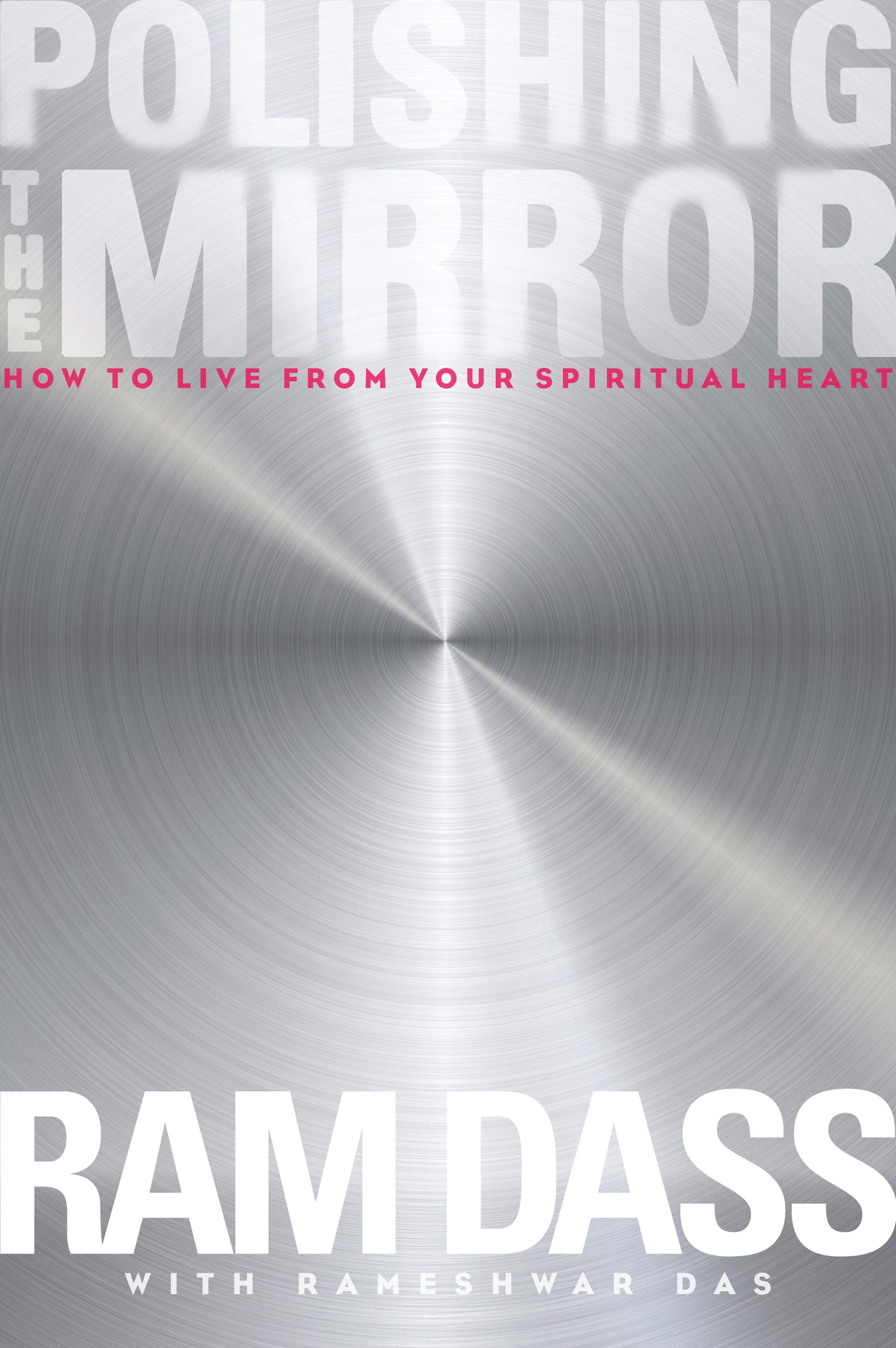
Ram Dass’ Polishing the Mirror: How to Live from your Spiritual Heart is a personal narrative and instruction manual for those interested in deepening their practice on a spiritual level. Through the use of personal narrative, Dass uses a combination of insight, humor, stories, and guidance from his own practices to illuminate a deeper level of consciousness: “The spiritual journey is not about acquiring something outside of yourself. Rather, you are penetrating the layers and veils to return to the deepest truth of your own being.” (6). By sharing his own journey of “polishing the mirror”, he reveals how  one’s authentic being is deeply seated within one’s heart: “Consciousness itself is a hall of mirrors. The key quality of the human soul is the ability to reflect on its own existence. Self-reflection, introspection, self-inquiry – whatever we call it – takes us through many layers of the onions of our inner being, . . . “ (170).

According to Dass, “Bhakti is the path of the spiritual heart, using our human emotions to forge the connection between the human and the divine.” (13). He also emphasizes love is a state of being: “. . . love isn’t possessive. We can’t collect it. We can only become it” (16), and these teachings can be found anywhere, “You don’t have to rush off to India, because the guru and the teaching are always right where you are, right here, right now.” (20). It is a process that requires our faith to reveal “the impurities and imperfections of our individuality that keep us from becoming one” (22). Additionally, karma is our dharma, “As a conscious being, you do all you can to live in your soul and to create space for others to be in their soul too.” (34). This requires our bearing witness as a neutral observer to our own attachments. According to Dass, “everything we notice in the universe is a reflection of our attachments.” (36). Thus, “living a spiritual life is a strategy for working on yourself for the benefit of all beings.” (44). This witnessing of our feelings and emotions allows us to simply observe, acknowledge, permit it to be, so we can eventually release them. In turn, “you also become a mirror for others to find their souls.” (119).

The account of “hanging out with blue Krishna and driving [slowly] along the New York Thruway” in a black limousine converted into a camper was hilarious.  The image of Dass with one hand on the wheel and mala beads in the other while singing to Krishna had to have been a sight to the state trooper who eventually pulled him over. The inner monologue of Dass, “Wouldn’t Krishna come as a state trooper? Christ came as a carpenter” makes one consider the possibility of the divine in all living beings (57).

Dass continues his narrative reflecting on the aging and dealing with change, “Old age trains you for change – change in your body, change in memory, chance in your relationships, change in energy, chance in your family and social role – all leading to death” (65). I, myself, have noticed these gradual changes with each passing year. Now at the age of 51, my priorities have changed, my circle of friends has grown smaller, and I am more committed to my yoga practice on and off my mat. Maybe I have become “irrelevant” for some, but it has given me more time to do inner work and to shift from “doing” to “being” (73).

His chapters dealing with death and dying really resonated with me. I am no stranger to hospitals, acute care facilities, and nursing homes. I have even assisted in hospice care for quite a few friends and relatives. As Dass recounts, I, too, have witnessed the “deception” given to those who are dying and to the caretakers as a means of easing the fear, guilt, pain and suffering (85). Personally, I was honored to be present for the transition of an uncle, my husband’s grandfather, my father, my mother, and my beloved felines, Smokey and Bandit. It is the ultimate offering one can give by being present and giving permission to let go; it is the “most exquisite manifestation of service” (89).

Dass’ description of dying reminded me of a collection of poems written by Emily Dickenson that explored death and dying. One in particular explores the senses and how they become confused and blended (synesthesia): 

I heard a Fly buzz – when I died –
The Stillness in the Room
Was like the Stillness in the Air –
Between the Heaves of Storm –

The Eyes around – had wrung them dry –
And Breaths were gathering firm
For that last Onset – when the King
Be witnessed – in the Room –

I willed my Keepsakes – Signed away
What portion of me be
Assignable – and then it was
There interposed a Fly –

With Blue – uncertain – stumbling Buzz –
Between the light – and me –
And then the Windows failed – and then
I could not see to see –

The last stanza reveals the synesthesia of the senses: “blue” being a color that is seen; “stumbling” being a sensation that is felt; “buzz” being a sound that is heard. Dass’s description of dying reveals a process associated with the elements: “As the earth element leaves, your body will feel heavy. As the water element leaves, you will feel dryness. As the fire element leaves, you may feel cold. As the air element leaves, your out-breath will be longer than your in-breath. The signs are now here. Don’t get lost in the details. Let your awareness go free.” (91).

With death comes suffering. Recounting the 4-Noble Truths of Buddhism, Dass emphasizes that attachments are the “clinging of mind – to attractions and aversions” that create a false sense of the self.  To demonstrate how suffering can be eased, Dass uses his suffering from a stroke as an example: “identify with being a witness of pain. Physical pain is in the body, and I am not my body.” (102). By shifting our perspective about suffering, it can be viewed as a “fire that purifies” or possibly “the teaching you need in the moment.” (108). It is through these experiences that we can become compassion: “You don’t have compassion – you are compassion. True compassion goes beyond empathy to being with the experience of another.” (109). 

Despite the passing of various loved ones, the one that hit me the most was the passing of my dearly beloved father. He was the epitome of unconditional love and compassion. Throughout my life, he was always there for me; he encouraged me in ways that my mother did not; he loved me in ways that my mother was unable to. What made his passing particularly difficult was the fact that my son, then 2 years of age, would grow up without truly knowing him.  As a means to cope with his passing, I came across a Sushila Blackman’s book titled Graceful Exits: How Great Beings Die; reading through this compilation of death stories from Hindu, Tibetan, Buddhist, and Zen masters, I found some reassurance and solace in the loss. After reading this particular chapter in Polishing the Mirror, I was reminded of Ramana Maharshi from our visit to the Sri Ramanasramam in Thiruvannamalai, India; I consulted Graceful Exits to find an account of his passing: 

The end came on April 14, 1950. That evening the sage gave darshan to all the devotees in the ashram. They sat singing Ramana’s hymn to Arunacala, the name of the holy mountain the sage so loved. He asked his attendants to help him sit up, and opened his luminous and gracious eyes for a brief while. There was a smile, a tear of bliss trickled down from the outer corner of one of his eyes, and at 8:47 pm his breathing stopped. There was no struggle, no spasm, none of the signs of death. At that very moment, a comet moved slowly across the sky, passed over the summit of the holy hill, Arunacala, and disappeared behind it.

(Blackman, 56).
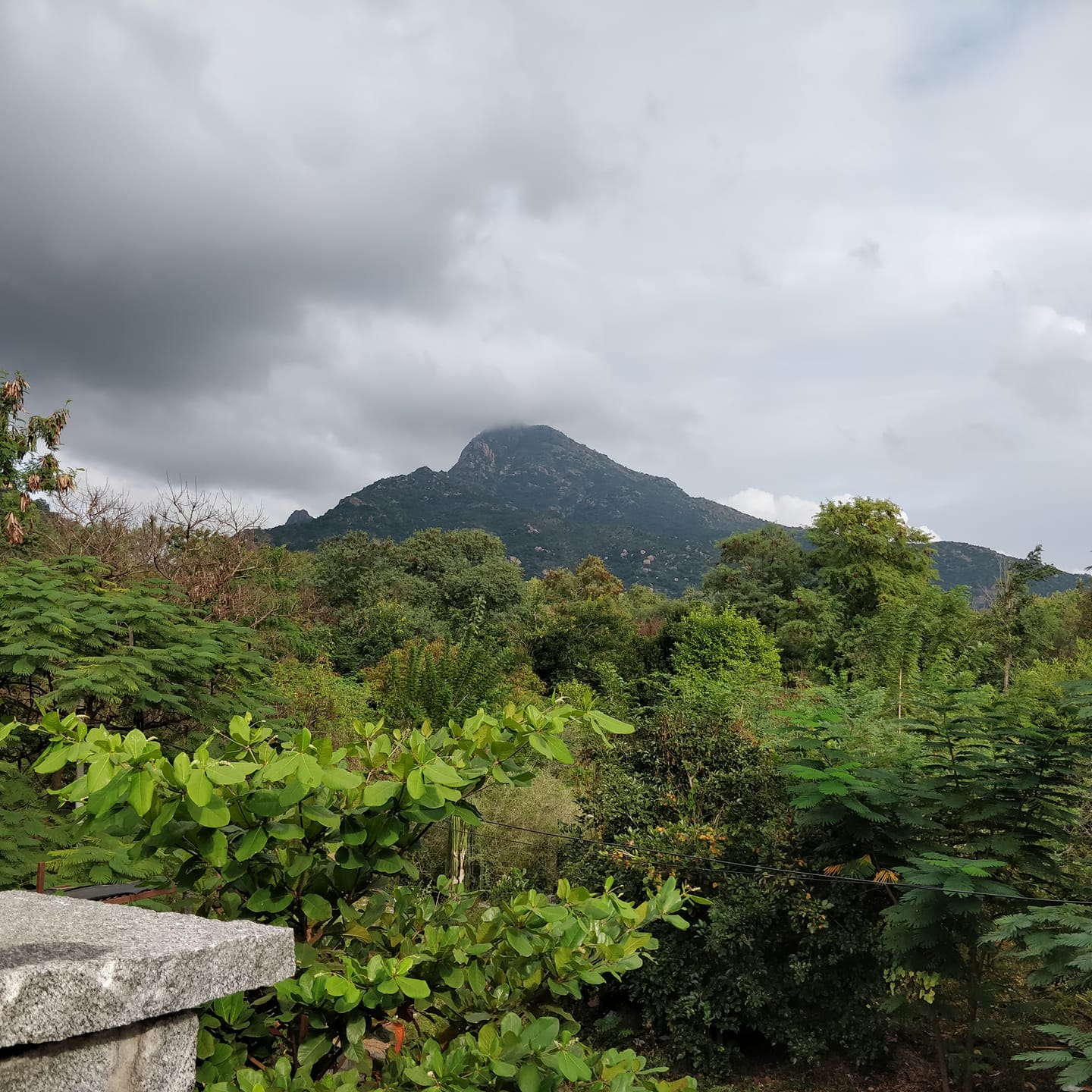
Mt. Arunachala is one of the five main shaivite holy places in South India.
— in Tiruvannamalai.

Indeed, Sri Ramanasramam demonstrated supreme compassion not only towards others, but especially towards himself. In his own words, “There is no need for alarm. The body is itself a disease. Let it have its natural way.” 

Dass concludes his narrative with various forms in which to “polish one’s own mirror” through practicing daily mediation, honoring silence, expressing gratitude, participating in Kirtan, recognizing realized beings, and listening to one’s intuition.

Works Cited:

Blackman, Sushila. Graceful Exits: How Great Beings Die. Shambala, 2005.

Dass, Ram. Polishing the Mirror: How to Live from Your Spiritual Heart. Sounds True, 2014.

Dickinson, Emily. “I heard a Fly buss – when I died -” (591). Poetry Foundation.

The Inspired Yoga Teacher

Posted: August 30, 2021 in Book Reviews

Gabrielle Harris’s The Inspired Yoga Teacher: The essential guide to creating transformational classes your students will love is quite the toolbox! Much of the information is reminiscent of all the training I have completed with Janet. The book is organized by beginning (soul-full starts, setting foundations, and starting shapes), meaningful middles, and divine endings. Of all the yoga-related texts I have read over the years, this book is a comprehensive incorporation of the 5-elements, chakras, prana vayus, deities, yamas, and niyamas. Each section begins with “To the Mind” (breakdown of the Sanskrit, benefits, related language and themes), “To the Heart” (dharma, science, application to everyday life, analogies, etc.), “To the Body” (asana with cues and variations), and “Teaching Notes”.

I was particularly impressed that Danda Pranam (Full Prostration) was included as I did not learn about it until my training with Janet. Under the “To the Body” is the script titled “Honour”:

Honour your life.The comings and goings.The falling apart and coming together.Honour your lineage.What was handed to you and what you will pass to others is your gift to the world.Honour who you are.What you know and don’t know.Your strengths and vulnerabilities.All of these make you beautiful in some way.Honour your feelings.The sadness, the bites of…

p. 253

Another concept that was further elaborated on that many other texts do not mention are the Prana Vayus. Harris notes where each vayu is seated, what it governs, how it moves, the corresponding chakra and element, as well as symptoms of imbalance. She then elaborates on incorporating the vayus in practice: asana, breath, mudra, and bandha. This section helped to further solidify Janet’s teachings.

The “Flow with the Deities” section includes Hanuman, Kali, Shiva, Arjuna. As with the other sections, each begins with “To the Mind” translating the deity’s name, a brief discussion on lineage and iconography, as well as the pose associated with the deity. “To the Heart” offers the story associated with the deity’s revered characteristics and mantra. “To the Body” begins with detailed pranayama practice, followed by asana sequence(s) and related cueing leading to the peak pose. The “Teaching Notes” offer additional guidance followed by “To Your Life” in how to manifest the deity in our everyday life.

The “Sutra Stitches” elaborates on the Yoga Sutras, particularly providing detailed guidance for each of the yamas and niyamas. Similar to the previous sections, each is tailored for the particular yama/niyama. For example, the section on “Tapas” includes a Home Practice for the morning and evening; Svdhyaya includes a Self-Myofascial Release.

Overall, I am impressed with this text. It is well-laid out, thought-out, and insightful. As someone who appreciates organization and concision, this text is perfect for me. While all of my training notes are housed in a 4″ binder, color-coded, labeled, and organized by training, this comprehensive toolkit will prove to be an invaluable supplment to my It also allows me to refresh my memory when planning classes.

Work Cited:

Harris, Gabrielle. Inspired Yoga Teacher: The Essential Guide to Creating Transformational Classes your Students will Love. Luminary Press: Coppell, 2021.

Having practiced with Janet since 2011 and training with her since 2016, I am familiar with her style and approach. Through various classes, trainings, and retreats, my appreciation of “slowing down” has been enhanced. In the beginning, I was like Kartikeya – fierce and intense not only in my practice but also in my everyday life.  Since more formal training with Janet, I have become more like Ganesh – calm, patient, and content both on and off my mat. 

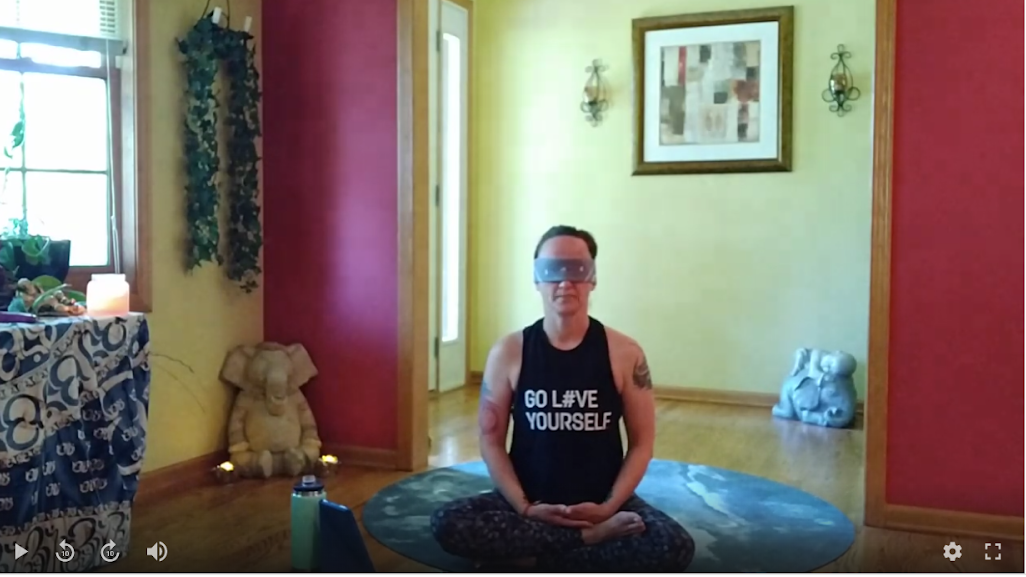
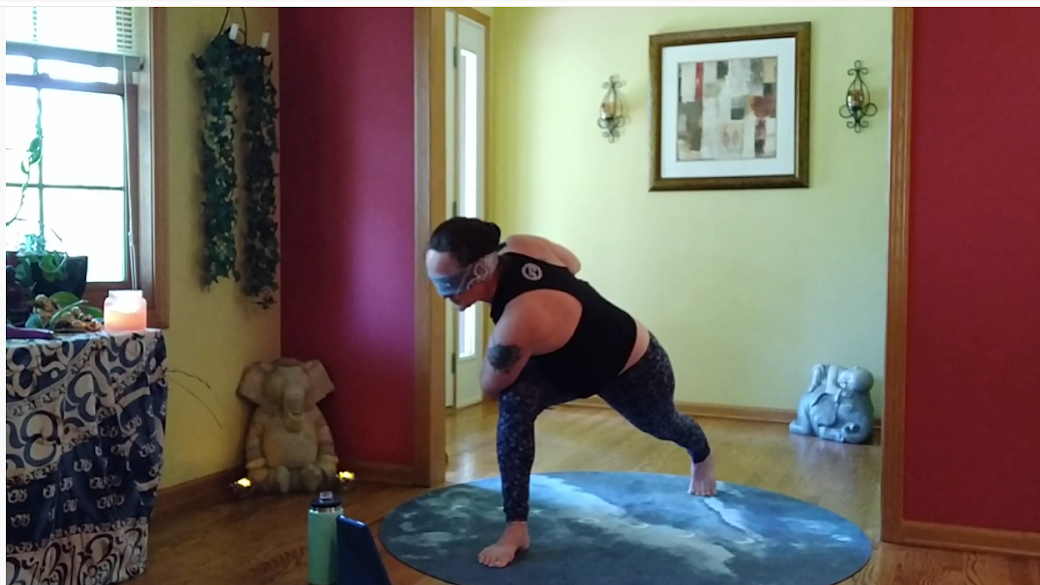
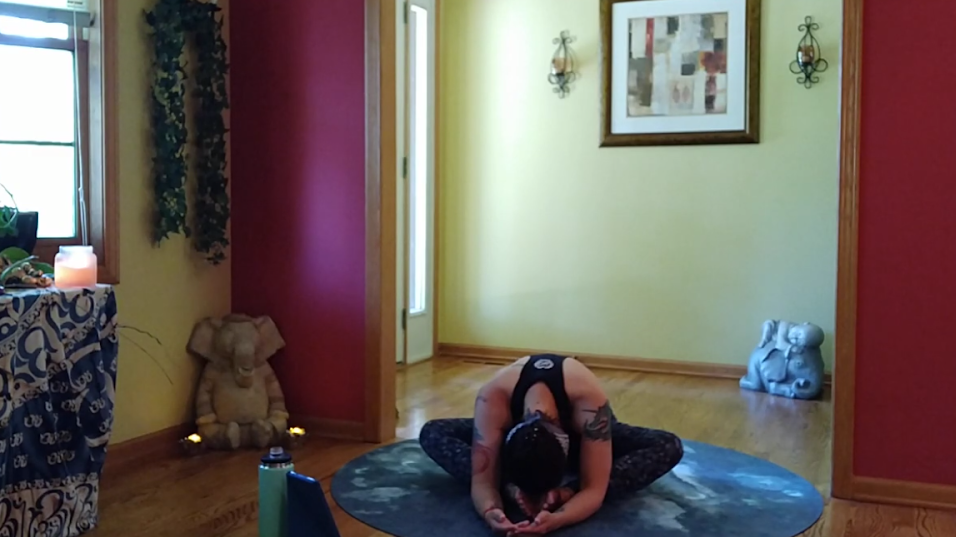
One of the things that really resonated with me in this course were the opportunities to disengage visually. Similarly to the use of blindfolds in her Art of Assisting (specifically Module 3: Foundations and Connections), Janet employed the use of eye pillows and “tenting” in restorative postures. The practice becomes very different without the aid of visual stimulation during the more active and energetic asanas, as well as in the less active, restorative asanas. For me, disengaging the visual heightens my other senses of awareness. 

During my initial 200-hour yoga teacher training with Jonny Kest back in 2011, I was introduced to his concept of Slow Flow: a grounding practice utilizing the complete yogi breath in a darkened room, without vinyasas or balance postures, and music without  lyrics; a practice in which one should be able to complete blindfolded. As part of our training, we were given an opportunity to practice blindfolded. Once placing the blindfold over my eyes, I recall an immediate sense of panic evident in my heart rate and breath. I was very clumsy and distrustful during the beginning of the practice, but once I was able to set aside my fear and reservations, an entirely new practice opened up to me – one that was more sensual and intuitive. I had to slow down and utilize my other senses: listening carefully to his cues and the breathwork of those around me, focusing on my own breath and my connection with the earth, feeling my heartbeat and the sweat on my skin. 

Since this class with Jonny, I have refrained from using my eyeglasses during my practice – visual aids that have become necessary in my everyday life due to excessive use of my eyes over the years; I also frequently close my eyes throughout my practice.  For me, closing the eyes is the ultimate level of self-acceptance and self-trust. After a few injuries, I have become more mindful in my practice and welcome the opportunity to slow down and give myself permission to rest when needed – or as Max Strom states, “Warrior 4.” Through Janet’s trainings, I have come to enjoy the benefits to my nervous system, giving myself permission to rest when needed, expanding my proprioception, and truly connecting with my breath. In my own teachings, I encourage students to elevate their practice by doing the same –  to slow down, to pause, to notice, and to bring their gaze inward. I have also led monthly blindfolded sessions per students’ request. 


This unprecedented time is like a dramatic pause; in literary terms, it is defined as a beat or two of silence that is usually done to heighten the anticipation before the big reveal. The global COVID-19 pandemic has been a much-needed “dramatic pause” in my life; my being “busy” 70+ hours a week decreased to 25+ hours a week. During this time, I was forced to embrace the opportunity to slow down, to sink in, to marinate, to relax, to simply “be” – so this course was perfectly attuned to this surreal time. Having most of the props available in my own practice space,  I was able to lean into the support offered, even if awkward at the beginning. Now, I use blocks more often in my practice – especially under my shoulders when prone, or under my tailbone, mid-back, base of skull, or the ankles when supine. As with the assisting training, I have had to experiment with my own body – which has enabled me to not only identify, but to address my own areas of need. This “dramatic pause” has been healing and nourishing for me as I gradually began to accept and connect to subtlety while allowing myself to be held in blissful, and rest. On or off the mat, when we give ourselves an opportunity to pause, to notice, and to feel, we discover something deep within ourselves.

I was also pleased to revisit the student-teacher mantra first introduced to me recently while in India by Shiva Kumar: 

“Oṃ saha nāv avatu

saha nau bhunaktu

saha vīryaṃ karavāvahai

tejasvi nāv adhītam astu

mā vidviṣāvahai

Om śhānti śhānti śhāntiḥi”

Aum! May we two be protected together. May we be nourished together. May we work together with heroic vigor. May our study together be filled with light. May there never be enmity between us. May it be so. Peace, peace, peace on all levels.

Mantra

Photo Credit: Paula Subler


I look forward to sharing this mantra when in-person classes resume. However, our world as teachers may never be the same – I’m not sure how assists and the restorative asanas will be accessible with the limitations on hands-on assists, the usage and sharing of props. Like the Assist training, I will welcome it as an opportunity to slow down, to be creative, to be open, and to be accepting of the what is, as it is – known, unknown, and within.

Oṃ 🙏


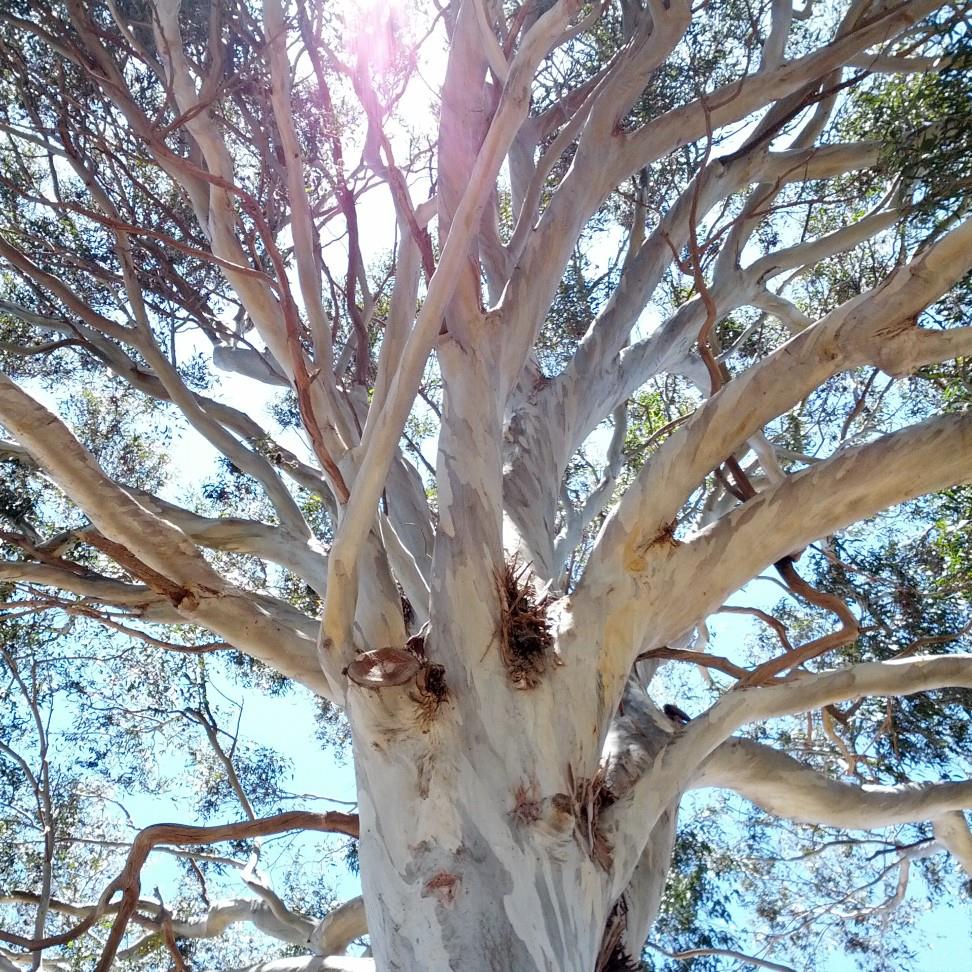
Eucalyptus Tree, San Luis Obispo, CA (2013)

There is definitely a difference between “fixing” and “assisting.” Over the years of practice with various teachers, I have personally experienced both. In some instances, I was taken out of my range of motion and subsequently injured. In other instances, I was taken out of my own head and subsequently discovered something deeper within myself. I have had teachers place their weight on me: standing or lying on my back, wrenching my spine deeper in a twist, tugging on my arm for a bind, or projecting their personal opinions, beliefs, and political agendas. I have had teachers trust me to rely on my own weight: granting me permission to observe without expectations, without judgement; offering verbal and gentle tactile cues to enhance my awareness.

My initial teacher training focused on Ashtanga with an emphasis on adjustments:

ad·just·ment /əˈjəstmənt/ noun: a small alteration or movement made to achieve a desired fit, appearance, or result.

https://www.lexico.com/en/definition/adjustment

While there are many yoga practices that focus on alignment, I have found verbal cues to be most effective in ensuring student safety during an asana practice. Forced adjustments seek to “fix” a posture for ultimate physical benefits and aesthetic purposes. However, I have found over my years of teaching and practicing, that not every posture is for every body. My first teacher would state that we all have “issues in our tissues”, thus making certain postures difficult for some people.  Over time, I have learned my limitations and am working to accept rather than fight against them. So for me, “fixing” implies that something is wrong, whereas “assisting” implies guidance and empathy.

In Levine’s Waking the Tiger, “Traumatic symptoms . . . stem from the frozen residue of energy that has not been resolved and discharged; this residue remains trapped in the nervous system where it can wreak havoc on our bodies and spirits.” (19). According to Levine, I suffer from Developmental Trauma. Through the many years of practice, I have learned a lot about myself as the “decades”, maybe “lifetimes”, of suppression and these conditioned patterns surfaced in my practice – my fear of inversions, my difficulty with backbends, a general distrust of my intuition, and even the fear of my voice – all spilled out and exposed on my mat (149). According to Pema Chodron in Start Where You Are, “We come to have a sense of letting our experience be as it is without trying to manipulate it, push it away, or grasp it.” (7) It is less about “fixing” and more about “assisting” towards acceptance.  Through the continued practice and training, yoga has become a “transformative” way of life for me (Levine, 1), an opportunity to “. . . letting our experience be as it is without trying to manipulate it, push it away, or grasp it.” (Chodron, 7). 

The Cliffs Hotel & Spa, Pismo Beach, CA (2013)

Through assists, I began to identify with the ebb and flow of sensations as “compressed energy” that I have held onto for so many years as they were revealed in my practice (Levine, 76). “Acting out and repressing are the main ways that we shield our hearts, the main ways that we never really connect with our vulnerability, our compassion, our sense of the open, fresh dimension of our being. By acting out or repressing we invite suffering, bewilderment, or confusion to intensify.” (Chodron, 31). I recall struggling through various asanas in the very beginning, being ego-driven to simply accomplish the posture in the basest physical form. However, “. . . compassion starts with making friends with ourselves, and particularly with our poisons – the messy areas.” (33. 46). Years later, as Pema states,  “the first step is to develop compassion for our own wounds,” I was able to connect these sensations with the developmental trauma of my childhood (Preface).

Pismo Beach, CA (2013)

Almost every time I come to my mat, something new is revealed; under the right guidance, an inner freedom is opened or released in the form of an inversion, a back bend, or even singing.  It is through these experiences that I also became aware of how my sense of self is heavily based on past experiences and how new information has filtered through that previously determined sense of self (Levine, 121). My practice evolved to “The moving away from comfort and security, is stepping out into what is unknown, uncharted, and shaky – that’s called enlightenment.” (Chodrom, 18). Indeed, yoga has become my adaptive process allowing for the gradual renegotiation of the “sheaths of memory” relating to the traumas of my lifetime, and quite possibly the traumas of lifetimes before, and “What you do for yourself, you do for others, and what you do for others, you’re doing for yourself” (33). This is part of the practice that I attempt to share when I teach, for “If we enjoy what we are experiencing, to think of other people and wish for them to feel that.” (7). By developing unconditional compassion for myself “leads naturally to unconditional compassion for others.” (Preface). Afterall, “If you can know it in yourself, you can know it in everyone.” (37).

Photo Credit: Sanjin Kastelan, Croatia (2018)

As a teacher, I have to be in the right space – mentally, physically, energetically, and spiritually before teaching a class, especially when offering assists in a class. Every class must begin with moments of stillness, not only for my students, but also for myself. I have to ground myself, calm my mind,  and set my intention for the class, and I guide students to do the same. Through the breath, I am able to bring myself to the present moment, to “Be right there with the breath as it goes out,” is the same thing as saying, “Be fully present.” (Chodron, 5). As it has been my own personal experience, it is my belief that each person has the ability to connect to his/her intuitive nature if given the opportunity and the space to do so, “You can give something that will help someone else connect with their own insight and courage and gentleness, rather than further polarize the situation.” (102). These assists come in the form of verbal and tactile cues: creating more awareness of one’s mind and body at the present moment with compassion and acceptance. As Chodron states,

Buddha is our inherent nature – our buddha nature – and what that means is that if you’re going to grow up fully, the way that it happens is that you begin to connect with the intelligence that you already have.

Chodron, 98

Works Cited:

Chodron, Pema. Start Where You Are: A Guide to Compassionate Living. Shambhala: Boston, 2011.
Levine, Peter A. Waking the Tiger: Healing Trauma. North Atlantic Books: Berkeley, 1997.

“Lord Ram gave Hanuman a quizzical look and said, “What are you, a monkey or a man?” Hanuman bowed his head reverently, folded his hands and said, “When I do not know who I am, I serve You and when I do know who I am, You and I are One.” ― Tulsidas, Sri Ramcharitmanas

This quote is reminiscent of the closing dharmā talk for “Living the 8-Limbs” training with Janet. Indeed, it has been a journey to the self through the self on many levels. Since beginning my training with Janet in 2016, I have discovered much about myself and have been able to embed a lot of the teachings in my own practice as well as incorporate them into my teachings. Throughout this particular training, I found myself spending a great deal of time with each module, some more than others. I was also blessed to have witnessed and experienced the first and second limbs in action while in India. In the end, I have much work to do, but the journey of unpacking continues with more awareness.

First Limb: The Yāmas

The first limb entails The Yāmas that provide guidance with regards to ethical practices through the use of restraints.

Ahiṃsā, the first of the yāmas, dictates nonviolence and compassion. According to Nicolai Bachman in The Path of the Yoga Sutras, “By law of cause and effect, every action has a consequence” (144). Commonly referred to as karma, “I alone am responsible for my thoughts, words, and actions” (147). Indeed, what you put out into the universe comes back to you. The various triggers that may move one towards violence and/or non-compassion include feelings of fear, imbalance, powerlessness, and self-loathing.  Deborah Adele in The Yamas & Niyamas makes a very clear distinction with regards to fear, “We need to know the difference between the fears that keep us alive and the fears that keep us from living.” (23), Much of my deeply rooted fears and feelings of powerlessness stem from my traumatic upbringing. However, it also manifests itself in how I am towards others. According to Adele, “When we try to take someone out of their challenge or suffering, we take them out of the environment that offers them a rich learning experience” (34). There is definitely a fine line between helping and hindering, and I have to remember that my personal experiences are not those of others.

The second yāma, Satyā, is based on truthfulness and sincerity. Adele states, “There is profound courage to this kind of willingness to be raw with reality as it is, rather than to run from it or construct a barrier to soften it.” (54). The triggers that may cause one to lie, either to one’s self or to others, include: the need to protect one’s ego, to create a sense of belonging, or to assuage one’s fear of loss. For me, after a childhood preconditioned towards self-preservation and survival, it has been quite the battle to focus on the reality of the present moment. While I still waiver into preconditioning on occasion, I am better able to recognize it and take a step back: am I trying to protect myself? Am I trying to belong? What am I afraid to lose? Afterall, “To be a bold person of truth is to constantly look for what we are not seeing and to expose ourselves to different views than the ones we hold sacred.” (51).

“The victories of truth have never been won without risks” – Gandhi.
Astēya, the third of the yāmas, involves non-stealing from others. While at first it appears like an obvious commandment “thou shall not steal” it actually goes beyond to include the moments and experiences of others. For example, “If we interrupt someone during a conversation, we steal their right to be heard.” (Bachman, 154, 163). Being solutions-oriented with a wide range of experiences, I often have to stop myself from offering my own personal experience, suggestions, feedback, and opinions. Over time, I have learned that life struggles are not always a bad thing: “Often we mistake these tasks as a burden rather than an opportunity to grow our compassion and skill level.” (Adele, 72). However, my life struggles are mine alone and do not necessarily apply to others. Over the years, I have been working on actively listening and allowing others the opportunity to process. In this sense, “Receiving is giving as well.” (Bachman, 155). Adele takes it further and on a personal level for me, “All self-sabotage, lack of belief in ourselves, low self-esteem, judgements, criticisms, and demands for perfection are forms of self-abuse in which we destroy the very essence of our vitality.” (66). My being a perfectionist with low self-esteem manifests in my need to be useful and helpful. 

The fourth yāma, Brahmacharya, concerns the conservation of vital energy and advocates non-excess. According to Bachman, “Throughout life, it involves control, moderation, pacing ourselves, and maintaining our inner orientation” (158). However, on a deeper level, Adele states “Practicing non-excess preserves and honors this life force within us, so that we can live with clarity and sacredness” (81). Feelings that might trigger excess or wasting of energies include feelings of avoidance, denial, isolation, and insignificance. As a mother and professional educator, I often struggle with balance between my work and personal lives. I often sacrifice my own practice and well-being for the sake of others. Additionally, when  feelings of insignificance arise, I devote more energy towards those areas in my life in which those feelings reside. Now that I am more aware of these tendencies, I am in the process of finding more balance. 

“We begin to see the sacred in the ordinary and the ordinary in the sacred.” (Adele, 82).

Aparigraha, the final yāma, concerns non-hoarding. I found myself reflecting on this yāma more than the others probably because it is the one I struggle with the most. My “hoarding” is not of the material nature, but more about who I am in relation to my past. For most of my life, I have embraced my past as contributing to the person I am today: a survivor, strong, compassionate, and courageous. While I understand the nature of impermanence, I continue to find myself grasping to this identity. According to Adele, “Subtle attachments come in the form of our images and beliefs about ourselves.” (95). Despite my traumatic upbringing, I have done very well to persevere. However, how does the “story” continue to serve me? In what way does it continue to define me? Why am I so attached to it? Clearly, I have to find a way to let go of the past, for “Letting go of the ownership opens us up to full engagement with what is set before us in the present moment.” (98). Since my abuser passed several years ago, I have been able to let go of the story a little bit at a time. 


Second Limb: The Niyāmas

The second limb entails The Niyāmas that provide guidance with regards to one’s personal self-care.

The first of the niyāmas is Saucha, cleanliness of “our bodies, our thoughts and our words” (105). According to Adele, “Cleanliness is a process of scrubbing the outside of us; it changes our outer appearance. Purification works on our insides and changes our very essence.” (109). However, she further clarifies, “Purity is not our attempt to make something different than it is, rather it is to be pure in our relationship with it, as it is in the moment.” (109). Again, the emphasis is on the present moment. Personally, it also reminds me of my need to control, especially when my reality is beyond my control. This typically manifests itself through my “perfectionism” in my immediate environment. Over the years, I have been “stepping back into a quiet space, regrouping our thoughts, updating our to-do list, and organizing our workspace in order to calm the heart-mind and reduce stress and anxiety” (Bachman, 76).  As a result, I have become far less reactive, but again, there are moments in which my control waivers.

“I enter fully into each experience, / and I come out fully from each of them, too. / I put the whole of me into all I do, / and . . . out of all I do.” – Krishnamurti

Santoṣā, contentment and gratitude, is the second niyāma – it “is being grateful for what we have and content with who we are and where we are in life.” (Bachman, 179). I was first introduced to this niyāma during the 5-Elements training in Mexico, 2016. Since the training, each and every one of my practices incorporates moments of gratitude. However, while I have immense gratitude, I also struggle with attachment in my practice as well as in my teaching. According to Bachman, “One aspect of contentment is being unattached to the results of our actions” (181). Adele pinpoints this succinctly, it “invites us into contentment by taking refuge in a calm center, opening our hearts in gratitude for what we do have, and practicing the paradox of ‘not seeking’” (120). Feelings of complacency, regret, and seeking happiness have kept me from finding balance. However, I am gradually becoming more aware of staying present, because “There is nothing more that can or does exist than this very moment.” (122).

Kriyā-Yoga

The last three niyāmas are grouped to form Kriyā-Yoga: Tāpas, Svādhyāya, and Iśvara-Praṇidhāna. Collectively, they create a practice in action in which “to weaken our mental-emotional afflictions (kleśas), and cultiplate complete attention (samādhi).” (Bachman, 186).

Tāpas, the third of the niyāmas, relates to one’s physical practice that serves to cause positive change. According to Bachman, “Tapas creates heat and thus change” (190). Indeed, if it doesn’t challenge you, it won’t change you, thus “Change is necessary for progress to occur” (191). Since beginning a regular yoga practice over 14 years ago, what began as an ego-driven practice slowly evolved into a more mindful practice. There are instances in my own practice in which I challenge myself: holding a particular posture or attempting a posture in which I am laden with fear. Can I breath through it? Can I let it go if I don’t succeed? Can I do it without need or desire? Can I find balance between effort and effortlessness? Can I find comfort in discomfort? Indeed, Adele’s question encapsulates this inner dialogue, “Can we grow our ability to stay in the fire and let ourselves be burned until we are blessed by the very thing that is causing us the pain and suffering?” (141). Afterwards, it has been instrumental in my everyday life, particularly in those instances of crisis: “The promise of a crisis is that it will pick us up and deposit us on the other side of something.” (143). While I continue to have moments in which I want to “fight” or “flee”, my reaction has softened and become more mindful.

The fourth niyāma, Svādhyāya, is the study by and of one’s self. This niyāma was initially introduced to me during the Energetic Alignment and Intuitive Sequencing trainings. As stated earlier, the past few years have been an intense self-study for me. One of the required readings, Peter Levine’s Waking the Tiger: Healing Trauma was key in understanding the effects of my pre-conditioning. According to Bachman, “Self-observation gives us the power to convert old, harmful behavior into new, helpful action” (197-98). It is definitely a process of revealing the many “boxes” that constrain me (Adele, 149). These revelations have occurred throughout my practices and various trainings, thus making me more aware: “The witness is our ability to watch ourselves act and respond. It is our ability to watch our thoughts and our emotional disturbances . . . . The witness is our ability to watch the ego rather than identify with it.” (159). Not only does every single practice begin and end in stillness to observe, but I catch myself pausing throughout my day to simply observe and to witness. According to Adele, “self-study is about knowing our true identity as Divine and understanding the boxes we are wrapped in. This process of knowing ourselves, and the boxes that adorn us, creates a pathway to freedom.” (149). For me, Bhaktī reveals qualities that I have either discovered within myself or am still seeking to find, afterall, “We are, at the core, divine consciousness.” (149).

“We don’t see things as they are, we see things as we are.” – Anais Nin

Iśvara-Praṇidhāna, the final niyāma of Kriyā-Yoga, is surrending with humility and faith. According to Adele, “Surrender invites us to be active participants in life, totally present and fluid with each moment, while appreciating the magnitude and mystery of what we are participating in.” (166). There are an innumerable amount of unknown variables throughout my day-to-day life – a long list of “What ifs” . . .  What if the weather or an accident affects my commute? What if I am in an accident? What if my students are “off the chain” today? What if my son is having a bad day? However, “Faith in the unknown can neutralize fear of the unknown.” (Buchman, 202). Referring back to the Yāmas, it requires us “To be strong enough to engage each moment with integrity and at the same time to be soft enough to flow with the current of life” (Adele, 172). Surrendering is by no means a passive act – it is a struggle that tests our integrity and requires an immense amount of courage (170). It also requires trust and faith in a divine force and acceptance “that whatever happens, happens.” (165, 204).  For me, “Hanuman Bolo” immediately comes to mind in my daily “leaps” into the unknown.
The Third and Fourth Limbs

The third and fourth limbs entail one’s personal practice, to include Āsana and Prāṇāyāma.  Āsana is the refinement of the body. Through physical practice, “impurities are churned up and released, allowing our life force (prāṇā) to flow more easily and improving our overall well-being.” (Bachman, 207). The physical practice also entails the regulation of breath, known as Prāṇāyāma since “Breath is a physical manifestation of prāṇā” (212). According to Bachman, “Prāṇāmoves everything in the body, including blood, lymph, nerve impulses, and ions. It also moves within our subtle energy points (marmas), energy channels (nādis), and energy centers (chakras).” (212). Thus, “Breathing exercises manipulate the prana and directly affect the body and the mind through the nervous system.” (213). Considering the importance and effects of prāṇāyāma, “The aim of Āsana is to reduce any hyperactivity in the nervous system” (208). In the early years of my yoga practice, it was purely about perfecting the postures and very little to do with my intuition or breathwork. Now, my practice focuses more on my breathwork and intuitively responding to what my body communicates to me in my physical practice.

The Fifth through Eighth Limbs

The fifth through eighth limbs concern one’s inner development known as Saṃyāma, inward concentration. Collectively, it is a means to move towards subtly and deeper the various layers of pre-conditioning. It begins with Pratyāhāra, the fifth limb, by tuning out sensory distractions where “we do not register sights, sounds, or other sensory details around us and are no longer distracted by external objects” (218). By tuning out our sensory distractions, “The true nature of our heart-mind is transparency, which allows out inner light of awareness to shine through our being without distortion and illuminate our world with knowledge, kindness, and compassion.” (219). With my attempts to find balance in my life, this continues to be a struggle for me, thus calming the mind chatter (chitta vritti) has always been a challenge for me. However, I have found that in my practice, I am able to gradually increase my ability to tune out distractions.
Saṃyāma progresses through to the sixth limb, Dhāraṇā, which Bachman defines as “keeping the attention on a single place” (227). Through the use of prāṇāyāma, we can draw our focus to one single point to help us to eliminate distractions; it entails becoming quiet, finding stillness, and acceptance of the present moment. Bachman suggests, “It is said in the Katha Upanishad (Kaṭhopaniṣad) that a flame the size of a thumb burns continuously in the heart, like a pilot light of life” (228). Janet’s guided meditation for Saṃyāma drawing attention to a focal point and allowing it to expand outward and then contract inward is something I will be incorporating to help me not only with the Pratyāhāra, but with maintaining that focus.

By extending the duration of focus leads us to the Seventh Limb, Dhyāna. According to Bachman, “Dhyāna blocks out the afflictive thoughts and emotions, allowing our heart-mind to absorb only the positive energy of the chosen object” (232). Here, one surrenders without any need to control and sets aside any pre-conditioning, and “If our chosen object is our heart, then we realize the same holds true for ourselves” (233). Once complete attention is attained, one enters the Eighth Limb known as Samādhi. Described as a spontaneous interaction with the here and now in complete and pure awareness, it becomes a realm of non-duality: “At this stage, there is no perception of a subject separate from its object.” (235). 

“It is by going down into the abyss that we recover the treasures of life. Where you stumble, there lies your treasure.” – Joseph Campbell

As my reflection indicates, the long and arduous journey continues. Indeed, there is a lifetime of constructs and pre-conditionings that I need to work through. However, through these training sessions and my continued practice, the “boxes” reveal themselves, making me more mindful and aware. When I forget who I am, I will look deep within and remember.

Jaya Sita Rama, Jai Jai Hanuman 🙏

Works Cited:

Adele, Deborah. The Yamas & Niyamas: Exploring Yoga’s Ethical Practice. On-Word Bound: Duluth, 2009.

Bachman, Nicolai. The Path of the Yoga Sutras: a practical guide to the core of yoga. Sounds True: Boulder, 2011.

The Path of the Yoga Sutras

Posted: April 22, 2020 in Book Reviews

pathNicolai Bachman’s The Path of the Yoga Sutras: a practical guide to the core of yoga, is a very comprehensive text that provides very accessible means to understanding Pantanjali’s Yoga Sutras. Divided into five consecutive sections: Key Principles, Understanding Suffering, Outer Behavior, Personal Practices, and Inner Development, the author presents the key philosophical concepts of not only the ancient text, but also reveals the foundation necessary for an authentic yoga for the modern practitioner. The text is organized to build upon the former to create a very comprehensive text. 
treeEach chapter covers a key concept, along with a relevant quote, analysis, thoughts and exercises for the practitioner. The author applies the principle to various modern examples and experiences, thus making it more accessible to the reader. For example, in Chapter 31 titled “Asteya” Bachman states, “If we interrupt someone during a conversation, we steal their right to be heard.” (154). According to Bachman, “The philosophy of yoga so eloquently written in these sutra-s is truly universal and nonsectarian” thus making it a practice, or a path, for anyone regardless “of time, place, culture or religion” (xx, 253).

DSCF5553

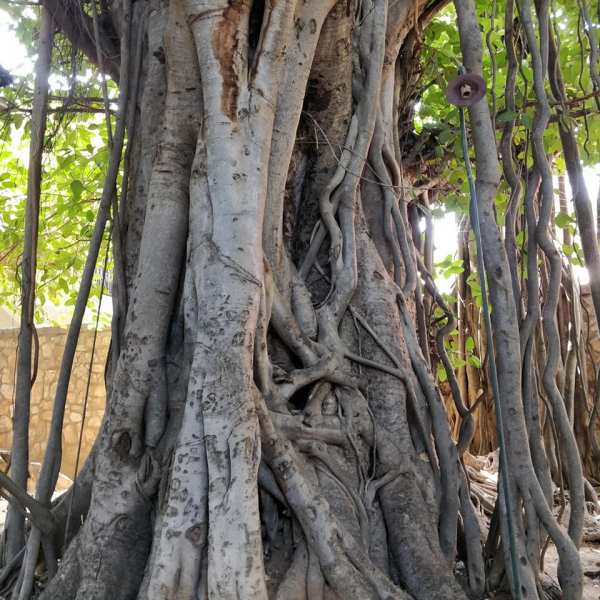
Photo Credit: Sanjin Kastelan Croatia, 2018

While Part I covers many of the key principles necessary in understanding the Yoga Sutras, Part II covers key terms that helps the reader to understand suffering, to include our misperceptions, afflictions, lack of awareness, and distorted sense of self – all of which can affect our outer as well as inner behaviors. Understanding the key principles in Parts I and II were necessary in helping to understand the subsequent sections arranged from outside of our self to our inner self. I truly appreciated the breakdown of the various principles – especially the elaboration of various sanskrit terms used throughout the reading and essential to understanding the Patanjali’s 8-Limbs.  As the subtitle of the text suggests, it is a very “practical guide” with a wealth of information that is “understandable to everyone and useful when applied to everyday living.” (253). For me, this will be a key text upon which I will return and reference often in my own practices.


Work Cited:

Bachman, Nicolai. The Path of the Yoga Sutras: a practical guide to the core of yogaBoulder: Sounds True, 2011.