Posts Tagged ‘yoga’

Bhakti Yoga, the path of devotion, centers on cultivating a loving connection with the divine. Unlike other yoga practices that emphasize intellectual understanding or disciplined action, Bhakti Yoga encourages us to approach spirituality with heartfelt love and surrender. In Chapter 9 of the Bhagavad Gita, Krishna explains that this path is accessible to everyone, regardless of background or circumstances. Through sincere devotion, we align with divine grace and find a deeper sense of purpose and peace.

Krishna teaches that Bhakti is about letting go of the ego and offering every part of our lives to the divine. As he says, “Whatever you do, whatever you eat, whatever you offer or give away, and whatever austerities you perform—do that as an offering to Me” (9.27). This teaching reminds us that every action—no matter how small—can be a form of devotion. Bhakti Yoga encourages us to infuse even the mundane tasks of daily life with a sense of sacredness. Whether it’s preparing a meal, working, or supporting loved ones, when done with love and intention, these actions become offerings that bring us closer to the divine.

A true devotee, as Krishna describes, is someone who remains steady through life’s challenges, treats others with kindness, and sees the divine presence in everyone. The transformative power of Bhakti lies in how it shifts our mindset—from focusing on self-interest to cultivating selfless love. This shift not only brings inner joy but also helps us approach everyday interactions with greater compassion and patience.

In practical terms, embracing Bhakti in daily life means finding ways to connect with the divine in whatever we do. It’s about approaching each moment—whether joyful or difficult—as an opportunity to practice love, gratitude, and surrender. Through this perspective, we can find a sense of purpose and fulfillment in the most ordinary moments, turning daily routines into a path of spiritual growth.
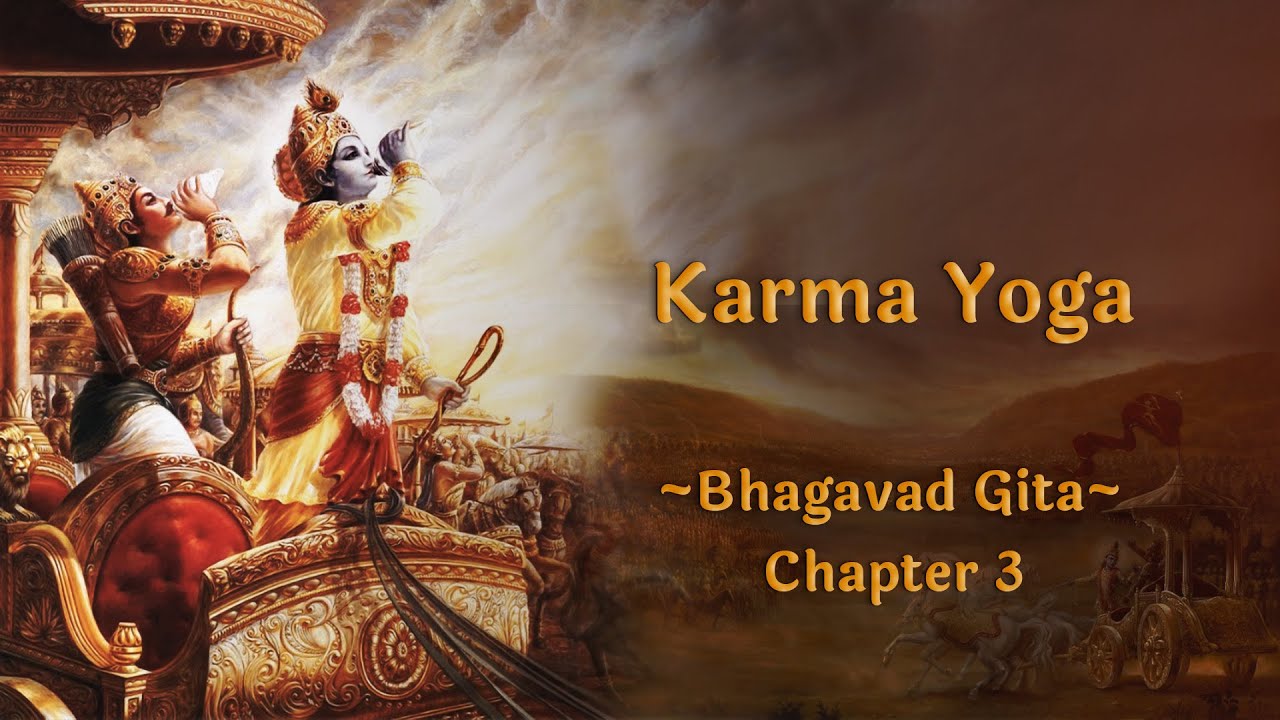
In Chapter 3 of the Bhagavad Gita, Lord Krishna introduces Karma Yoga, the Yoga of Action, as a path to spiritual liberation through selfless action. Krishna teaches that by performing one’s duties without attachment to the results, individuals align themselves with the cosmic order and contribute to the greater good. This detachment from the fruits of action is key to practicing Karma Yoga, where the focus is on fulfilling one’s responsibilities with sincerity and dedication.

Karma, central to Karma Yoga, refers to the law of cause and effect, where actions have corresponding consequences. However, Krishna reveals that by engaging in selfless action, one can transcend the binding effects of Karma. This approach purifies the heart and leads to spiritual growth and ultimate liberation (moksha), as it frees individuals from the cycle of birth and death.

To apply Karma Yoga in daily life, one must cultivate a mindset of dedication, detachment, and selflessness. Performing tasks with full attention and without concern for the outcome, while focusing on benefiting others, transforms ordinary actions into spiritual practices. This shift in perspective helps individuals live more purposefully, aligning their actions with the divine will.

Karma Yoga offers a practical path to spiritual freedom by encouraging selfless action and detachment from results. By integrating these teachings into daily life, we not only contribute positively to the world but also move closer to spiritual fulfillment and liberation.

Chapter 2 of the Bhagavad Gita, known as “Sankhya Yoga” or “The Yoga of Knowledge,” brings us some timeless wisdom from Lord Krishna to Prince Arjuna. Sankhya Yoga is all about gaining knowledge and clarity. It’s about understanding the deeper truths of life and distinguishing between what’s temporary and what’s eternal. This kind of discernment helps us navigate our daily lives with a better sense of purpose and direction.

Krishna also explains that our true self, or Atman, is eternal and indestructible. Unlike our physical bodies, which change and eventually perish, the Atman remains constant. This perspective can help us deal with fear and attachment, reminding us that our essence is something far greater than our physical form. In today’s world, this means not getting too caught up in appearances or material possessions, and instead focusing on our inner values and spiritual growth. Krishna emphasizes that our bodies are temporary and subject to change. Understanding this helps us detach from our physical selves and not place all our happiness on something that won’t last forever. In modern terms, it encourages us to look beyond physical health and beauty standards, and instead appreciate the deeper aspects of our being.

Dharma, or duty, is another key teaching in this chapter. Krishna urges Arjuna to do his duty as a warrior, highlighting the importance of fulfilling our responsibilities without getting attached to the results. This is highly relevant today—we all have roles and responsibilities, whether in our families, jobs, or communities. Performing these duties with dedication, but without obsessing over outcomes, can lead to a more fulfilling and balanced life.

These ancient teachings from Sankhya Yoga are incredibly relevant in today’s fast-paced world. They remind us to look beyond the superficial aspects of life and focus on what truly matters. By understanding the eternal nature of the self, we can reduce our fears and anxieties. Recognizing the impermanence of the body helps us shift our priorities from the physical to the spiritual. Embracing our duties with detachment allows us to perform our roles more effectively and find inner peace.

Arjuna’s Dilemma and Reluctance to Fight

In the first chapter of the Bhagavad Gita, we meet Arjuna, a warrior prince ready to battle at Kurukshetra. Looking at the enemy lines, he suddenly feels a deep moral and emotional crisis. The thought of fighting his own relatives, close friends, and respected teachers shakes him to the core. Arjuna, once confident, now finds himself engulfed in doubt and fear. This moment sets the stage for his journey from confusion to enlightenment, reflecting a common struggle between doing what’s expected and following one’s personal values.

Psychological and Spiritual Aspects of Arjuna’s Crisis

Arjuna’s struggle goes beyond just fear of battle. His crisis is both psychological and spiritual, mirroring what many of us face when confronted with tough choices. He’s torn between his duty as a warrior and the guilt of fighting loved ones. His mind is clouded with grief and attachment, leading him to question the purpose of life and his role in it. This chapter captures his internal conflict, symbolizing the broader human quest for meaning and balance in difficult times.

The Significance of Arjuna Seeking Guidance from Krishna

On the verge of breaking down, Arjuna turns to Krishna, his charioteer, for advice. This moment is crucial because it marks a shift in the story. By admitting his confusion and asking for help, Arjuna shows the importance of humility and openness to wisdom. Krishna, representing divine insight and cosmic order, becomes more than just a charioteer—he’s Arjuna’s spiritual guide. This highlights the value of seeking guidance from a wise mentor when facing life’s challenges.

Lessons from Arjuna’s Dilemma

Arjuna’s dilemma and his conversation with Krishna in the first chapter of the Bhagavad Gita offer timeless lessons. They remind us that inner conflicts and tough decisions are part of being human. This chapter encourages us to reflect on our own lives, seek guidance when needed, and look for a higher perspective in difficult situations. Arjuna’s journey from doubt to clarity is a powerful reminder that turning to a higher wisdom can lead to deeper understanding and peace. The wisdom from the Gita continues to resonate, offering insights into duty, righteousness, and finding inner calm.

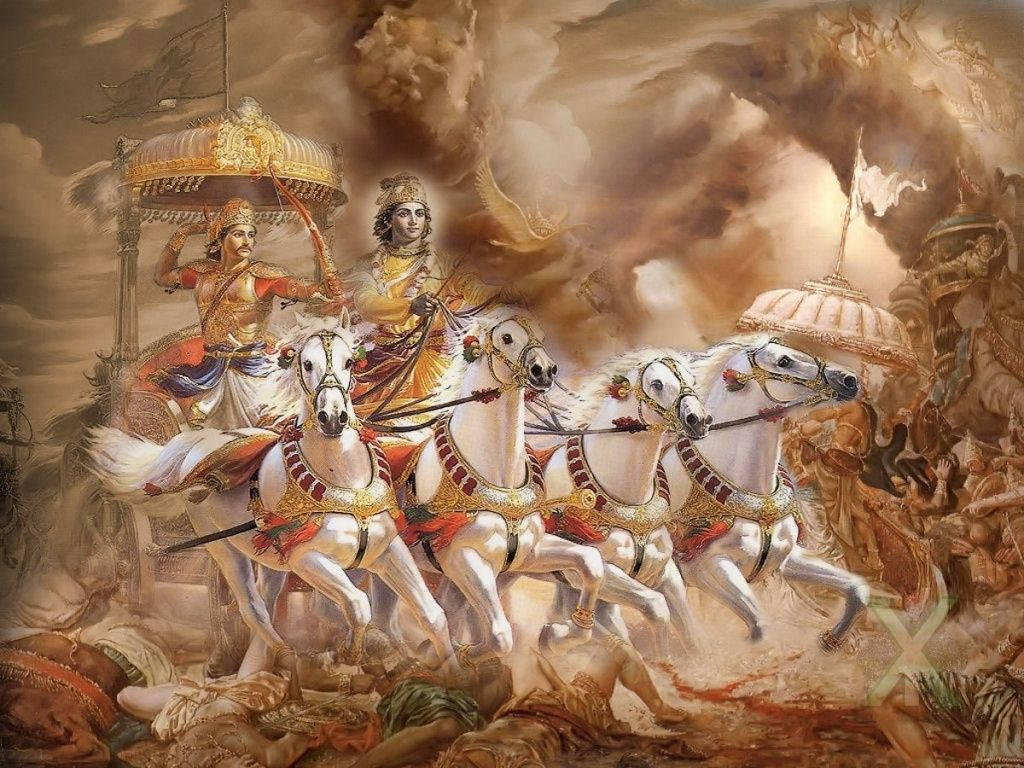
The Bhagavad Gita is not just an ancient text; it’s a timeless dialogue between Prince Arjuna and his charioteer, Lord Krishna, set on the brink of a great battle. It’s like receiving invaluable life advice from a trusted friend exactly when you need it most.

This revered scripture comprises 18 chapters with 700 verses, delving into profound insights about life’s purpose, ethical dilemmas, and the nature of reality. Its teachings are set against the dramatic backdrop of a war-torn Kurukshetra, offering practical wisdom amidst the chaos.

At its core, the Bhagavad Gita expounds upon different paths of yoga—spiritual disciplines—that lead to spiritual realization and liberation (moksha). These paths include Karma Yoga (the yoga of selfless action), Bhakti Yoga (the yoga of devotion), Jnana Yoga (the yoga of knowledge), and Dhyana Yoga (the yoga of meditation).

The beauty of the Bhagavad Gita lies in its exploration of various paths to spiritual fulfillment. It presents Karma Yoga (selfless action), Bhakti Yoga (devotion), Jnana Yoga (knowledge), and Dhyana Yoga (meditation) as transformative practices for achieving inner peace and self-realization.

Throughout this series, we’ll meticulously unpack each chapter, revealing how these ancient teachings remain relevant in our contemporary lives. Whether you’re navigating personal challenges or seeking deeper spiritual understanding, the Bhagavad Gita offers profound guidance that transcends time and culture.

anubhūtaviṣayāsaṃpramoṣaḥ smṛtiḥ
Memory (smriti) is retaining experiences.

Yoga Sutra 1.11

According to Patanjali, the last way of being is through remembering. Out of all the impressions you get in a day, the ones with strong emotions attached are the ones that stick. You might know someone who seems stuck in the past, always reminiscing about the good old days. This “old” attitude isn’t about age but about being attached to the past. This attachment might come from wanting to hold on to what’s gone or from trying to push away an old memory. Either way, it can drain your energy, leaving little for the present. Even obsessing over the future often ties back to past experiences, since your predictions are usually based on what happened before.

On the other hand, a “young” attitude is about seeing the freshness of each moment and responding with intelligence and grace. It’s not about thinking memories are bad or that you need to erase them. Memories are a part of your history and give you perspective. Instead, think about how you relate to your memories. Do you control them, or do they control you? Can you have a healthy relationship with your memories, and what would that look like?

One way to explore this is by looking at the emotional charge of a memory. Since emotions help create memories, understanding the emotional imprint can give you insight. Take a memory that’s important to you. Focus on the details, like what happened and who was there. Then, shift your focus to the emotional aspect. What emotions does this memory bring up? Do these emotions make you feel good, or do they drain your energy? When these emotions come up, do you push the memory away or hold on to it tightly? Can you just let these emotions flow through you until they fade, instead of keeping them bottled up?

As you practice this, notice any patterns in the emotional charges of your deep memories. Do these patterns suggest unresolved emotions? Reflecting on these memories, do they give you insights into your current attitudes and choices? Can you make peace with your memories and your past by letting go of their emotional charge, whether positive or negative? Recognize that past events have shaped who you are now. Accept that you probably made the best choices you could at each point in your past, even if you’d choose differently now.

Om Hari Om 🙏

abhāva-pratyaya-ālambanā tamo-vr̥ttir-nidra 

Sleep is the modification where the mind rests on the darkness that has no impressions.

Yoga Sutra 1.10

According to Patanjali, our minds stay active even during sleep, which is why we might not always feel fully rested. The quality of our rest depends on how focused our minds are when the brain, nervous system, and senses shut down. Instead of taking in new experiences, our minds often dive into memories and imagination, causing dreams. Even in dreamless sleep, the mind is still aware, hidden in a state called “mental stupor.”

Dreamless sleep gives the nervous system a break, making us feel refreshed after six to eight hours, but Patanjali suggests that mastering certain sleep techniques can provide even better rest in less time. Known as yoga nidra, this method involves being fully aware while sleeping, preventing the mind from wandering. Unlike regular sleep, where we are passive, yoga nidra allows us to sleep with awareness and control, offering complete rest and improving mental clarity and memory.

Maintaining a consistent sleep schedule, creating a comfortable sleeping environment, and incorporating yoga nidra into your daily routine can lead to deeper rest. To practice yoga nidra, lie down in a comfortable position like Savasana (Corpse Pose), close your eyes, and take deep, slow breaths. Scan your body, consciously relaxing each part from head to toe. Focus on your breath and surrender to the pull of gravity on each exhale. Incorporating yoga nidra will transform how you rest and wake up, leading to better mental clarity and improved memory.

Om Hari Om 🙏

Śabda-jñānānupātī vastu-śūnyo vikalpaḥ

Imagination (vikalpa) is a thought pattern that follows words and is devoid of any corresponding reality.

Yoga Sutra 1.9

After discussing knowledge and misunderstanding in the previous sutras, this verse explores imagination (vikalpa), defining it as the mind’s activity not based on direct experience. Imagination shapes the stories we tell ourselves and others, influenced by narratives from our upbringing, education, and social institutions.

For example, you might recall a childhood story often repeated by your parents. Even if you don’t remember the event, frequent retelling and related pictures can lead you to create a mental image, treating it as a real memory. This illustrates how we continually edit our life stories, seeking coherence in our actions and decisions. However, this process can make us believe in constructed stories, causing misunderstandings when different versions of an event conflict.

Imagination exists only in the mind and often appears ideal. When translating these ideas into reality, you may find discrepancies that cause agitation. This aligns with Patanjali’s sutra 1.5, which notes that our ways of being can be helpful or unhelpful. For instance, imagining a place you want to visit might create expectations that reality doesn’t match, triggering emotions that distract from the present moment.

In yoga, being present with what is, rather than what could or should be, is essential. Distinguishing between direct experience and imagination helps achieve this. Reflect on the stories you tell yourself: Are they based on direct experience or imagination? Exploring your imagination can reveal whether it contributes to meaningful goals or distracts you from conscious living. Consider whether your imagination enhances your life participation or detracts from it.

Om Hari Om 🙏

viparyayo mithyājñānamatadrūpapratiṣṭham

Misconception is false knowledge which is not based on its own form.

Yoga Sutra 1.8

Yoga Sutra 1.7 introduces Pramana as right or factual knowledge, while Yoga Sutra 1.8 describes Viparyaya as wrong knowledge or misperception. Viparyaya occurs when we mistake the unreal for the real, leading to false information and faulty knowledge. This happens when our mental image doesn’t match reality, creating an illusion where we can’t distinguish between what’s real and unreal.

In our yoga practice, Viparyaya can manifest when we push ourselves beyond our limits, ignoring the body’s signals of discomfort or pain. We might mistake our desire to achieve a pose for progress, leading to injuries or setbacks. Pramana, on the other hand, involves listening to our bodies, respecting their boundaries, and practicing mindfulness and awareness.

Viparyaya can also arise in our perception of progress in yoga. We might compare ourselves to others, thinking we’re not flexible or strong enough. This comparison can lead to feelings of inadequacy or frustration, clouding our ability to see our own progress. Pramana encourages us to focus on our own journey, celebrating small victories and honoring our unique strengths and limitations.

Sometimes we just need to take that dramatic pause and return to the safety of our breath. To cultivate Pramana in our yoga practice, we must learn to listen to our bodies, enhance our self-awareness, and practice with compassion and acceptance. By doing so, we can peel away the layers of misperception and experience the true essence of yoga – the union of mind, body, and spirit.

Om Hari Om 🙏

pratyakṣa-anumāna-āgamāḥ pramāṇāni

Right perception is through the senses, inference, and testimony.

Yoga Sutra 1.7

Pramāṇa literally means “proof” and “means of knowledge” which can lead to knowledge, including direct perception, inference, and testimony. Sutra 1.7 guides us in discerning correct information. Patanjali’s sequence of the three methods matters, progressing from the most reliable to the least.

pratyakṣa: Direct perception, the first and most dependable, involves experiencing something firsthand. What did you see, hear, or feel? It’s akin to learning to swim—you can read and watch, but true learning only happens in the water. In yoga, direct experience is paramount for self-discovery. Reflecting on our practice aids in absorbing and processing information.

anumāna: Inference, the second method, relies on logical reasoning. For instance, seeing smoke implies fire nearby. In yoga, we cultivate discernment by comparing our experiences—what happens if I do this versus that?

Śabda: Testimony, the third means, relies on information from trusted sources, be it writings or the wisdom of experts. Evaluating the authority’s credentials—how long have they practiced? What makes them an expert?—is crucial. Testing their recommendations in our practice helps determine reliability.

In today’s world of misinformation and diverse opinions, applying this sutra is crucial. Unsure amidst conflicting information? First, assess your direct experiences. Then, engage your intellect. Finally, consult trusted references. If all aligns, it’s reliable. But if conflicts arise, prioritize your direct experience over the opinions of others. Use logic to discern motives; independent researchers are often more reliable than biased corporate interests.

Navigating between right knowledge and letting go demands courage and discomfort, especially in embracing Vairagya, detachment. Yet, within this discomfort lies liberation—a freedom born from truth and release. This sutra holds profound wisdom; try applying its principles to something uncertain today. Let your conclusion settle, and in time, the truth will unveil itself.

Om Hari Om 🙏